Antenna Upgrade That Actually Helps Your Mesh Network
You bought a MeshCore node, set USA/Canada (Recommended), and still feel like Bryan–College Station is ignoring you. In a flat, tree-lined town, the next useful move is rarely “more watts.” It is usually a better antenna matched to where the radio actually lives — eave, mast, backpack, or truck — and a connector that is not fighting you.
This post is the product side of that decision. Our earlier guide Antennas & Rooftops: Why Your BCS Node Can’t Hear Anyone (Yet) covers height, line of sight, and plugging the LoRa port. Here we compare the antennas we keep reaching for on Brazos Valley Mesh builds: a compact outdoor ALFA, a tall Rokland fiberglass kit, handheld whips, and a flexible gooseneck for vehicles.
Quick answer
For most outdoor or solar boxes on a low Bryan–College Station roof among live oaks, start with a genuine ALFA Network AOA-915-5ACM and treat the “5 dBi” claim as optimistic marketing. Independent lab-style measurements put horizon gain closer to a ~2 dBi-class dipole, which is still a useful, broad pattern outdoors.
If you can put an antenna higher and clear of the tree canopy, step up to the Rokland ~32″ 5.8 dBi fiberglass kit. For handhelds and trail use, swap the stock stub for a Muzi Works 17 cm whip (the compact upgrade we’ve used and prefer) rather than chasing a GIZONT listing that advertises “10 dBi.” For a vehicle or any mount that needs to bend, use the MESHTAC Gooseneck 4 dBi from Rokland.
Match SMA vs RP-SMA and N-male vs N-female before you click buy — wrong gender is the classic first-week tax.
At a glance (no fancy table)
ALFA AOA-915-5ACM — best default outdoor/base for low eaves and solar boxes; claimed 5 dBi omni on 902–928 MHz; N-male on the antenna; buy genuine from Rokland or the authorized Amazon listing we link below; counterfeits exist.
Rokland 5.8 dBi 32″ fiberglass kit — elevated outdoor when you have mast or barn height; about 31.75″ tall; verify connector gender on the antenna versus the title, and expect an SMA-male cable end on the kit cable; buy from Rokland; there isn’t a clean single Amazon listing we trust for this kit.
GIZONT 17 cm whip — common handheld form factor with SMA male; Amazon titles often claim 10 dBi (marketing, not something we treat as verified). We discuss it by name only and point Amazon buyers to Muzi instead.
**MESHTAC Gooseneck 4 dBi — vehicle and flexible mounts; SMA male**; Rokland product name `MESHTAC™ Gooseneck Tactical Antenna 4 dBi gain SMA Male 915 MHz`.
Muzi Works 915 MHz 17 cm whip — the compact SMA-male whip we recommend for a handheld upgrade.
We are not recommending the Seeed 318020612 5 dBi fiberglass (community VSWR — voltage standing wave ratio — and damage reports), ultra-short ~5 cm Ziisor-style stubs, or stock T-Beam / T-Echo / LoRa32 whips for serious Bryan–CS use. Those belong on the “prove it powers on” shelf, not on a coverage node.
How we evaluated these for Brazos Valley Mesh
We care about what has worked for MeshCore nodes on the USA/Canada (Recommended) preset around Bryan, College Station, and the wider Brazos Valley — not about who prints the biggest dBi number on a stick. After flashing from flasher.meshcore.io, verify the shared preset lands near ~910.525 MHz / SF7 / BW 62.5 / CR5 before you judge the antenna.
Use case first. A backpack node, a truck gooseneck, a second-story eave, and a barn-peak mast are different problems. Gain patterns that look great on a tall clear mast can be the wrong shape on a low roof under trees.
Connector honesty. Most companion boards want SMA (or sometimes RP-SMA). Outdoor fiberglass and the ALFA often land on N-type. Buying the wrong gender or polarity means another pigtail, more loss, and a weekend of frustration. We call genders out explicitly below.
Claimed gain vs lived reality. Spec-sheet dBi is not a substitute for independent measurements or field feel. For the ALFA we cite the Antenna Test Lab theme we have used in prior BV Mesh writing: horizon numbers closer to a modest dipole than to a sharp 5 dBi omni. For GIZONT we refuse to amplify an unverified “10 dBi” claim.
Where you buy. Counterfeit ALFAs are a documented problem; Rokland publishes guidance and sells authorized stock. Prefer the product links in this post (Rokland or the Amazon listings we already use) over random third-party lookalikes.
What we skipped. Invented prices and pipe-markdown tables the site cannot render. Prices and stock move; recheck the seller page before you order.
Option 1: ALFA Network AOA-915-5ACM — best default outdoor and base antenna
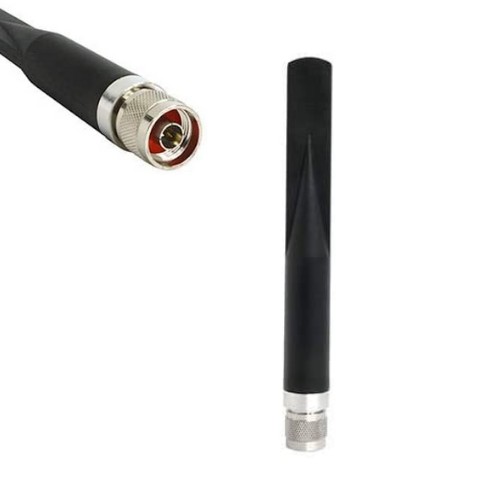
If we could put only one outdoor antenna on a typical Bryan–College Station MeshCore box — solar repeater, eave node, or “People’s Repeater”-style build — it would be a genuine ALFA Network AOA-915-5ACM (photo above). It is a compact outdoor omni aimed at 902–928 MHz, small enough to live on a low roof or enclosure without looking like a cell site, and tough enough for Central Texas weather when the feedline and bulkhead are sealed.
The connector is N-male on the antenna. Most LoRa companion boards expose SMA (or occasionally RP-SMA), so plan on an N-female pigtail or bulkhead on the radio side, then a short quality cable — not a six-dollar mystery adapter stack. Get the gender wrong once and you will remember it forever: N-male on the ALFA needs N-female on the mating cable or bulkhead.
Treat the “5 dBi” label with healthy skepticism. Independent Antenna Test Lab measurements of this ALFA family theme put horizon gain closer to roughly a +1 to ~2 dBi-class dipole across the 902 / 915 / 928 MHz neighborhood rather than a crisp 5 dBi lobe. That sounds like a downgrade until you remember what Bryan–CS actually looks like: low roofs, live oaks, apartment canyons near campus. A broader, modest-gain pattern often couples better into neighborhood paths than a taller, narrower stick still stuck under the canopy. Community reviews that call the 5 dBi claim “dubious” are not a reason to skip the antenna; they are a reason to buy it for what it is.
Buy authorized. Counterfeits exist, including cheap marketplace and AliExpress lookalikes with poor SWR. Prefer Rokland’s ALFA listing or the authorized Amazon listing linked above (sold through channels Rokland documents). Rokland’s own counterfeit guide is worth a skim before you chase a suspiciously cheap “ALFA.” A fake that looks identical in photos can still waste a solar install.
Best for: outdoor base nodes, solar boxes, eaves, and any MeshCore companion you intend to leave up among Brazos Valley trees without a tall mast.
Trade-offs: needs N-to-SMA (or N-to-RP-SMA) hardware; claimed gain oversells the lab reality; counterfeit risk if you buy random third parties.
Option 2: Rokland 5.8 dBi ~32″ fiberglass kit — when you can actually raise it
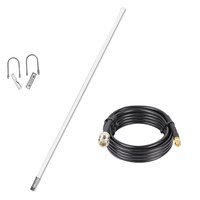
When the antenna can get above the oak line — barn peak, proper mast, or a second-story mount clear of the crown — the **Rokland Meshtastic® compatible 5.8 dBi N-Male Omni Outdoor 915 MHz Antenna kit** (about 31.75″, often sold as a “32″” fiberglass, with 6′, 10′, 15′, or 25′ cable choices) is the elevated outdoor step-up we point people at. The Meshtastic® label is Rokland’s product naming; on Brazos Valley Mesh we run the same class of 915 MHz hardware under MeshCore. Buy the kit from the Rokland store; there isn’t a clean single Amazon listing we trust for this kit.
Read the connector line twice before ordering. Listing titles in this category sometimes say N-male while the physical antenna body or kit contents need a careful check for N-female on the antenna versus the cable end. The kit cable is commonly described with an SMA-male radio-side end — perfect for many SMA boards, useless for an RP-SMA jack without the right adapter. Verify the product page photos and options for your board before the box ships.
Why bother with the taller stick? Height and a slightly higher-gain omni help when you finally have line of sight across flat Brazos Valley terrain. The same antenna on a kitchen table is still a kitchen-table antenna — our rooftops post is the placement half of this advice. Keep feedline as short and low-loss as practical; choosing a 25′ cable “just in case” can erase the upgrade if the run is mostly coiled junk.
Best for: elevated outdoor MeshCore nodes with real mast or structure height — including dedicated repeater builds that can clear the trees.
Trade-offs: longer, more visible, more wind load; connector verification required; Rokland purchase path for this kit (no clean Amazon listing we trust).

 If you want an Amazon-available outdoor fiberglass alternative while you wait on Rokland stock, suitable alternatives / honorable mentions include a Bingfu 915 MHz fiberglass with adapter cable and a Slinkdsco outdoor 915 MHz omni with N-male. Those are optional backups, not our primary BCS picks over the Rokland 5.8 kit or the genuine ALFA.
Option 3: Handheld whips — GIZONT by name, Muzi when you buy on Amazon
Stock whips on many T-Beam, Heltec, and similar boards are fine for proving the radio boots. They are a weak place to stop if you walk campus, bike the Bryan side, or sit a companion in a backpack. Community threads routinely swap them for a ~17 cm 915 MHz SMA whip.
GIZONT 17 cm whip shows up often in that conversation. It is typically SMA male, compact, and aimed at handheld or trail use. Amazon titles for this form factor frequently claim 10 dBi. That number is marketing, not a verified lab result we will stand behind — buy GIZONT for the form factor if you already like the listing, not because you expect a 10 dBi miracle from a short whip. We discuss GIZONT by name for the form factor; for an Amazon purchase path we point to Muzi instead.
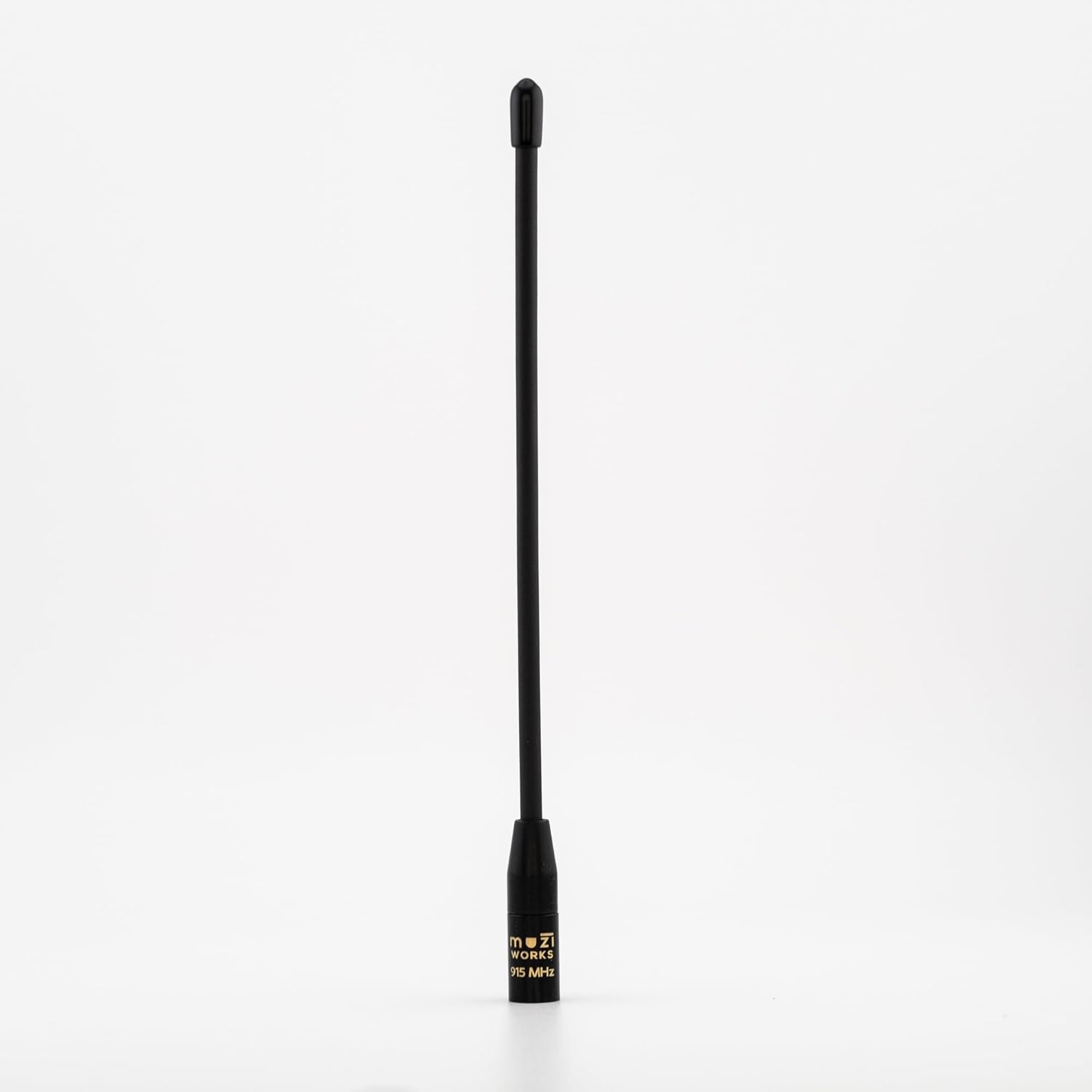
For a compact whip we recommend the Muzi Works 915 MHz 17 cm whip (photo above). It is SMA male, widely used as a stock-antenna replacement on MeshCore-capable boards, and it is the handheld upgrade we are comfortable linking. If you would rather order from Rokland, the MESHTAC 2.5 dBi soft flexible whip is also SMA male and was $12.97 on Oct 9; choose the 915 MHz option. Confirm whether your board is SMA or RP-SMA before ordering; polarity mistakes are as common on whips as on outdoor N-type gear.
Best for: L1 Pro-class companions, Heltec/RAK boards with external SMA, trail and campus carry.
Trade-offs: still a short antenna — height and clear sky matter; GIZONT’s dBi claims are not gospel; Muzi still needs the correct SMA vs RP-SMA match.
Option 4: MESHTAC Gooseneck 4 dBi — vehicle and flexible mounts
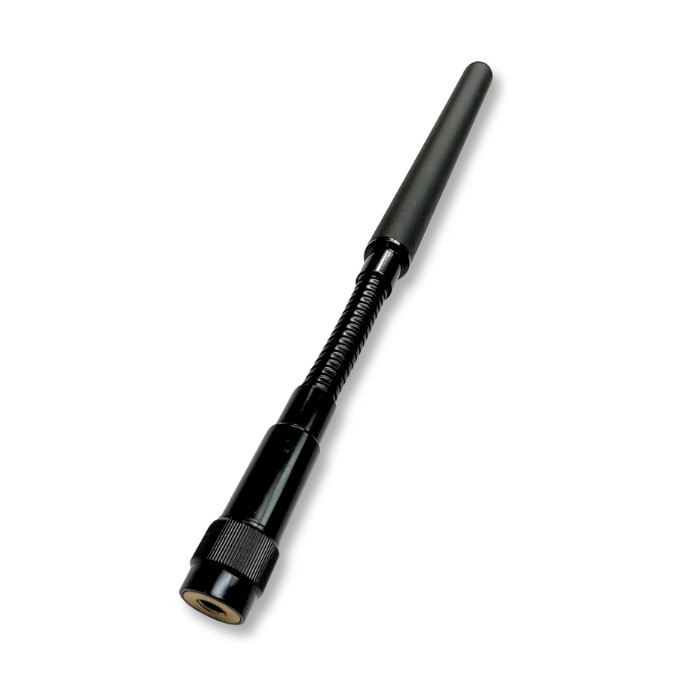
Trucks, ranch consoles, and any mount that gets bumped need something that bends instead of snaps. The Rokland MESHTAC™ Gooseneck Tactical Antenna 4 dBi gain SMA Male 915 MHz (photo above) is the flexible option we name for that job. SMA male.
A gooseneck will not out-range a mast-mounted fiberglass stick. It will survive a door slam and let you aim the tip toward a clearer window line while the node sits in a cup holder or on a dash mount. For Brazos Valley ranch roads and game-day parking, that practicality often matters more than another half-dBi on a brittle whip.
Best for: vehicles, temporary flexible mounts, nodes that get handled roughly.
Trade-offs: not an elevated outdoor base antenna; still requires the correct SMA vs RP-SMA jack on the radio.
Head-to-head: what actually differs
Pattern and height beat printed dBi. The ALFA’s honest ~2 dBi-class horizon behavior on a sealed eave often beats a “bigger” whip indoors. The Rokland 5.8 dBi kit pulls ahead when you finally clear the trees. Whips and goosenecks win on portability, not on barn-to-campus links.
Connectors are the hidden cost. ALFA = N-male antenna → need N-female mating hardware toward the radio. Rokland 5.8 kit = verify N gender on the antenna vs title, expect SMA-male on the kit cable end. GIZONT, Muzi, and MESHTAC gooseneck = typically SMA male — unless your board is RP-SMA, in which case stop and buy the matching whip or a proper adapter once, not three wrong ones.
Counterfeit and marketing risk. ALFA has documented fakes — stick to Rokland / authorized Amazon. GIZONT’s “10 dBi” is a reason to shop for form factor, not for a number. We would rather under-promise and have MeshCore neighbors hear you than inflate a listing.
MeshCore context. None of these antennas care which firmware you flash, but Brazos Valley Mesh runs MeshCore with the shared USA/Canada (Recommended) radio preset. A perfect ALFA on the wrong preset still looks like radio silence. Flash from flasher.meshcore.io, confirm USA/Canada (Recommended) (~910.525 / SF7 / BW 62.5 / CR5), seat the antenna on the LoRa port (see the rooftops post), then spend money on RF hardware.
Which should you choose?
New outdoor / solar / eave node in Bryan–CS: genuine ALFA AOA-915-5ACM, short quality pigtail, sealed bulkhead. Add height when you can.
You already have mast or barn clearance: Rokland 5.8 dBi ~32″ fiberglass kit from Rokland, shortest practical cable, verify N and SMA genders on the product page.
Handheld, campus walk, backpack companion: Muzi Works 17 cm whip via the Amazon link below (or a GIZONT-shaped whip if you already like that listing — still ignore “10 dBi” hype).
Truck, ranch, anything that bends: MESHTAC Gooseneck 4 dBi from Rokland.
Apartment near Texas A&M with only a window: a good SMA whip or gooseneck plus the highest clear pane you can use often beats shopping for outdoor fiberglass you cannot mount. Revisit ALFA when you have outdoor permission.
Buying from the Brazos Valley Mesh shop funds local coverage directly — including ready pocket mesh nodes and solar repeater mesh nodes. Buying the same class of gear elsewhere is completely fine; we would rather you get on the mesh than wait.
FAQ
Is the ALFA AOA-915-5ACM really 5 dBi?
Treat 5 dBi as a marketing ceiling, not a guaranteed horizon number. Antenna Test Lab–style measurements of this ALFA theme land closer to a modest ~2 dBi-class dipole toward the horizon across the 915 MHz ISM segment. It remains a strong compact outdoor default for low BCS roofs when you buy a genuine unit.
SMA or RP-SMA — how do I know?
Look at the board’s LoRa jack and the antenna listing photos side by side. SMA and RP-SMA reverse the center-pin gender, so a title that only says “SMA” is not enough. When in doubt, match a known-good cable or whip from the same vendor as your board, or compare center-pin photos with the antenna listing before you order. Do not assume “SMA” in a product title means the polarity your Heltec, RAK, or Seeed board actually exposes.
N-male vs N-female on outdoor antennas?
The ALFA AOA-915-5ACM is N-male. Your pigtail or bulkhead toward the radio needs the mating N-female (plus whatever SMA/RP-SMA the board wants). For the Rokland 5.8 dBi kit, verify the antenna-side N gender against the live product page rather than trusting the title alone, and confirm the cable’s radio-end SMA-male will fit your jack.
Should I buy GIZONT for the “10 dBi” claim?
No. Buy a short 17 cm whip for size and handling if that form factor fits your node. Treat “10 dBi” on a stubby handheld antenna as marketing. For that role we recommend the Muzi Works 17 cm whip instead.
Will a better antenna fix an empty MeshCore map by itself?
Not if you are on the wrong firmware or preset, the antenna is on the Bluetooth/Wi-Fi footprint instead of LoRa, or the node is in a ground-floor drawer. Pair this shopping guide with height and preset hygiene. Brazos Valley Mesh expects MeshCore and USA/Canada (Recommended) — flash at flasher.meshcore.io and verify ~910.525 / SF7 / BW 62.5 / CR5.
Why not the Seeed fiberglass or a 5 cm stub?
We are deliberately not recommending the Seeed 318020612 5 dBi fiberglass given community VSWR and damage reports we do not want to amplify as a “best of” pick, and ultra-short ~5 cm stubs give up too much for serious links. Stock device whips are fine for unboxing day, not for a coverage plan.
Final recommendation
Start with the use case, not the biggest printed dBi. Genuine ALFA AOA-915-5ACM for most Bryan–College Station outdoor and solar boxes; Rokland 5.8 dBi ~32″ kit when the antenna can get high and clear; Muzi 17 cm whip for handheld upgrades; **MESHTAC gooseneck when it has to flex; GIZONT** only as a named form-factor peer — not a faith-based 10 dBi expectation.
Match connectors once, seal outdoor joints, keep MeshCore on USA/Canada (Recommended), and spend your next hour of effort on height — that combination is what has actually helped on this mesh.
Gear links
- ALFA Network AOA-915-5ACM — also available from Rokland
- Rokland 5.8 dBi ~32″ outdoor omni kit
- Muzi Works 915 MHz 17 cm whip
- MESHTAC 2.5 dBi 915 MHz soft whip (Rokland)
- Optional outdoor fiberglass alternatives on Amazon: Bingfu 915 MHz fiberglass with adapter · Slinkdsco outdoor 915 MHz omni (N-male)
- MESHTAC Gooseneck 4 dBi (Rokland)
Shop and next steps
Support local coverage at the Brazos Valley Mesh shop, or grab a ready pocket mesh node / solar repeater mesh node if you want less DIY. For placement and empty-map debugging, read Antennas & Rooftops. For first-weekend setup, see Your First MeshCore Weekend in Bryan–College Station and Match the USA/Canada Preset.
Buying through our links or shop helps fund the mesh. Buying the same gear elsewhere is still a win — just get a correct connector and some height, then check in with neighbors on MeshCore.