
Best Handheld vs Rooftop Antenna for MeshCore: Which First?
Best handheld vs rooftop antenna for MeshCore depends on where your radio spends its day. If you carry it, upgrade the whip first; that costs about $13. If it sits at home, put an antenna on the roof, because height beats gain.
That is the short version of a question we get a lot around Bryan–College Station: "Should I buy a better whip, or should I put something on the roof?" They solve different problems.
A whip upgrade makes the radio you carry a little better wherever you take it. A rooftop antenna makes one fixed spot a lot better, and if it runs as a repeater, it makes the whole neighborhood better.
Our 915 MHz antenna upgrade guide compares specific antennas, and our antennas and rooftops guide covers placement and the empty-map checklist. This post is about the decision between them. Prices were checked on Oct 11, 2026.
Quick answer
You carry your node (pocket, backpack, truck): replace the stock antenna with a good 915 MHz SMA whip like the Muzi Works 17 cm whip or Rokland's MESHTAC 2.5 dBi whip. It costs about $13, it takes a minute, and it helps everywhere you go. It will not turn a ground-floor apartment into a hilltop.
Your node stays home: an outdoor antenna on an eave or roof, like the ALFA AOA-915-5ACM on a short cable, will usually do more than any whip. Plan on roughly $28 to $55 for a basic eave setup, and more for a mast, longer coax runs, and lightning protection.
You have a good high spot and want to help everyone: put a repeater up there instead of an antenna for your own companion. On MeshCore, companions never repeat other people's traffic, so a rooftop companion helps you, while a rooftop repeater helps the whole map.
Most people end up doing both: a whip on the radio you carry, and height at home or on a hosted repeater.
Why height beats gain
Two pieces of physics do most of the work here, and neither one cares about the dBi number printed on the box.
The first is the radio horizon. A common rule of thumb for radio signals is that the horizon in miles is about 1.41 times the square root of the antenna height in feet. A radio at chest height, about 5 feet up, has a horizon around 3 miles. An antenna 25 feet up on a two-story roof has a horizon around 7 miles. The two horizons add together, so a handheld talking to that roof antenna has roughly 10 miles of theoretical room. In Bryan–College Station, trees and buildings usually get in the way well before the curve of the Earth does, but the point holds: height buys distance that no whip can.
The second is the Fresnel zone. A radio signal does not travel along a thin laser line. It travels through an oval-shaped zone around the straight path, and obstacles inside that zone weaken it even when you can "see" the other antenna. Standard guidance is to keep at least 60% of the first Fresnel zone clear. At 915 MHz on a one-mile path, that zone is about 38 feet in radius at its midpoint. Keeping 60% of it clear means roughly 23 feet of open space around the line at the midpoint.
Two handhelds at chest height cannot have that, because the ground, the fences, the cars, and the live oaks are all inside it. A roof antenna gets part of the way there. A mast or a barn peak gets more.
Gain is a much smaller lever. In open space, signal loss rises about 6 dB every time distance doubles, so you need roughly 6 dB more link margin to double your range. A good 2.5 dBi whip in place of a decent stock antenna gains you a decibel or two on paper. The exception is a bad stock antenna. One Reddit owner measured the stock antenna on a T-Beam 1W at an SWR of 9.8, as we note in our 1-watt mesh node guide. Replacing a poorly matched stub with a tuned whip can matter more than the gain number suggests.
Higher gain on an omni antenna also flattens its pattern. Rokland lists a 35-degree vertical beamwidth for its 5.8 dBi fiberglass kit. That is great on a mast looking out across flat Brazos Valley terrain, but it is not a reason to stand a tall stick in a window behind trees.
What a handheld whip upgrade actually buys you
A whip upgrade is cheap, fast, and portable. It goes wherever you go: a walk across campus, a bike ride on the Bryan side, a game-day tailgate, or a truck on a ranch road. Most companion boards with an external jack use an SMA female jack, and most good whips are SMA male, so it simply screws on. Our SMA vs RP-SMA vs N-type connector guide shows how to check yours in 30 seconds.
What it will not do is change your height. Your body also blocks and absorbs some of the signal on the side you are facing away from, so clipping the node high on a backpack strap, or setting it on a dash with the antenna clear of the roof pillar, often matters as much as the antenna itself. The first MeshCore node under $70 guide covers which companions take an external antenna at all. The SenseCAP T1000-E, for example, has its antenna built in.
Who it is for: anyone whose radio moves, and anyone who wants to improve today for the price of lunch.
What a rooftop antenna actually buys you
A rooftop or eave antenna changes the geometry. It lifts the antenna out of the clutter around your house, so your home radio can reach repeaters and neighbors it could not hear from a desk. In our experience around Bryan–College Station, a desk node in a ground-floor apartment has lost to a node with a cheap whip in a second-story window every time we have compared the two. The eave or roof is the next step past the window.
It also costs more, in money and in effort. You need the antenna, a way to connect it to the radio, something to mount it on, weather sealing, and often a lightning arrestor. You also need permission if you rent or have an HOA.
Coax is the hidden cost. Every foot of cable between the antenna and the radio loses signal. Times Microwave lists typical loss at 900 MHz of about 7.6 dB per 100 feet for LMR-240 and about 3.9 dB per 100 feet for LMR-400. So 25 feet of LMR-240-class cable throws away roughly 1.9 dB, which is about what a whip upgrade gains you. The best answer is a short cable: put the radio in a weatherproof box near the antenna, or mount the antenna close to a window the radio already sits beside.
Companion or repeater? This is the part that is specific to MeshCore. A companion pairs with your phone over Bluetooth and does not repeat anyone else's traffic. If you run a companion off a rooftop antenna, it helps you. If you put a repeater on that roof, it helps everyone within range of it, which is why our rooftop repeater write-up says one well-placed repeater has been worth more to the town map than several radios on desks.
Bluetooth also isn't designed to reach a phone through a roof, so a rooftop companion usually means the radio stays inside on a cable run. If you have a great high spot, the hosting page explains how a small, weatherproof repeater with no cable into the building works on our mesh.
Lightning and weather. If coax runs from the roof into a building, put an N-type arrestor where it enters and bond it to a real ground. Seal every outdoor joint with self-fusing tape. Central Texas heat, humidity, and storms find unsealed connectors fast. Our heat, humidity, and lightning guide covers the rest. None of this is electrical-code advice, so follow the arrestor maker's guidance and local code.
Who it is for: a home base station, a radio that stays plugged in, and anyone with a roof, eave, barn, or shop they are allowed to use.
When to do both
Doing both is the normal end state, not an extravagance. Here is the order that has worked for us. First, upgrade the whip on the radio you carry, because it is cheap and helps right away. Next, move a node to your best window and see what you hear. Then add height: an eave antenna for a home base radio, or a repeater on a roof or barn if you have one to offer.
A household with two radios is the classic case. One companion goes with you, and the second stays home on the window or eave antenna. That is also why we suggest starting with two radios. A mesh of one is just a radio.
The antennas and parts we would actually buy
These are the specific pieces for each path. Check your board's jack before ordering. Most companion boards are SMA female, but some gear uses RP-SMA.
Option 1: Muzi Works 17 cm whip — the handheld upgrade
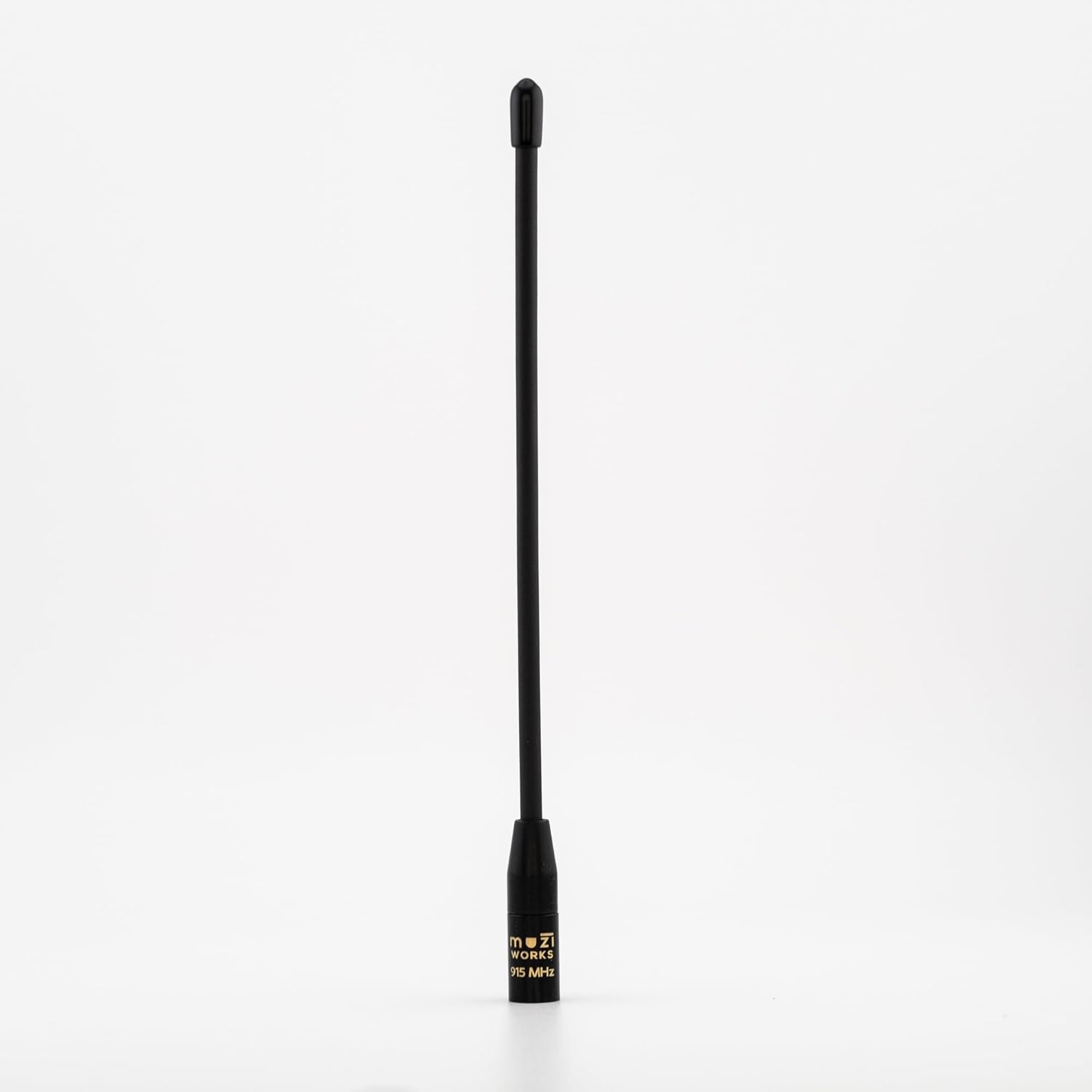
The Muzi Works 915 MHz 17 cm whip is the compact SMA male whip we recommend for a companion you carry. It replaces the stock stub in about a minute and needs no adapters. If you would rather order from Rokland, the MESHTAC 2.5 dBi soft flexible whip is also SMA male and was $12.97 when we checked. Choose the 915 MHz option.
Best for: pocket and backpack companions, campus walks, and anyone who wants the cheapest real upgrade.
Trade-offs: it is still at chest height. It improves a weak antenna, not a bad location.
Option 2: MESHTAC Gooseneck 4 dBi — trucks and rough handling
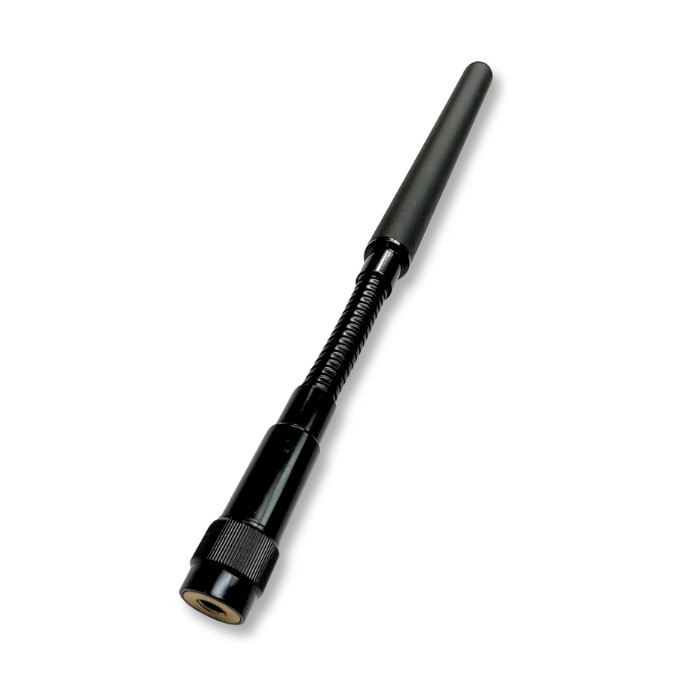
The MESHTAC Gooseneck Tactical Antenna 4 dBi from Rokland is SMA male and bends instead of snapping. That matters on a dash, in a truck console, or on a pack that gets thrown around. You can aim the tip toward the clearest window instead of where the radio happens to sit. It was $34.97 when we checked, in flat-top or round-top 915 MHz versions.
Best for: vehicles, ranch roads, and nodes that get handled roughly.
Trade-offs: it costs more than a whip, and it is still a mobile antenna, not a base station.
Option 3: ALFA AOA-915-5ACM — the first rooftop or eave antenna
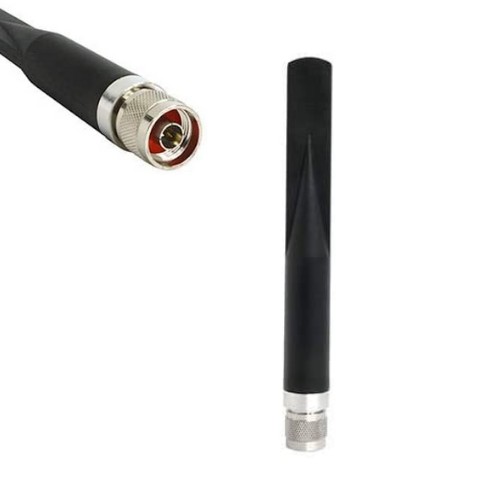
The ALFA Network AOA-915-5ACM is the compact outdoor omni we reach for on low Brazos Valley roofs and eaves. Rokland lists it as about 7 inches tall, weatherproof, 50-ohm, and N-male. Its "5 dBi" label is optimistic, as our antenna upgrade guide explains, but its broad pattern suits low roofs among trees.
It was $14.97 at Rokland when we checked. Pair it with the SMA male to N-female adapter ($5.97) if the antenna sits at the enclosure, or the shortest SMA male to N-female low-loss cable that reaches ($10.97 for 12 inches, up to $32.97 for 15 feet of 240-grade cable). Add a roll of RokTape ($6.97). That puts a basic eave setup at about $28 to $55 before any mount.
Best for: a home base node on an eave, a low roof, or a solar box.
Trade-offs: it needs an SMA-to-N part, and counterfeits exist, so buy from Rokland or the linked listing.
Option 4: Rokland 5.8 dBi fiberglass kit — when you have a mast
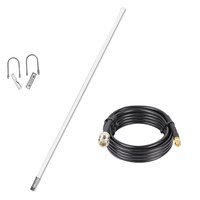
When the antenna can clear the trees, from a barn peak, a real mast, or a tall roofline, the Rokland 5.8 dBi Omni Outdoor 915 MHz Antenna kit is the taller step up. It is about 31.75 inches of fiberglass with a 35-degree vertical beamwidth, a U-bolt bracket, and a cable that ends in an SMA male connector. On Oct 11 it ran $49.97 with a 1-foot cable, $52.97 with 3 feet of 400-grade cable, and $59.97 to $64.97 with 10 or 15 feet. The 6- and 25-foot versions were out of stock. Rokland notes the kit does not include a pole.
Best for: a fixed node or repeater with real height and a clear view across town.
Trade-offs: it has more wind load and is more visible, and its flatter pattern wastes its gain if it is stuck below the tree line.
Honorable mentions
If you want a whip that is easy to spot in a bag, the Color MESHTAC 2.5 dBi whip comes in red, white, green, and yellow for $12.97. If coax enters a building, the RAKwireless N-type lightning arrestor was $24.97 at Rokland, and 10-gauge bare copper grounding wire starts at $14.97 for 10 feet. For the 5.8 dBi kit, which ships without a pole, Rokland's 12-inch outdoor pole mast with U-bracket was $19.50 and screws to a wall, fence, or fascia. Check that your antenna's bracket fits its 1.5-inch pole.
What we would skip: a tall fiberglass antenna in a window, a long coil of thin cable "just in case," and any handheld listing that promises 10 dBi from a short whip.
Which should you choose?
You carry one radio and nothing is mounted yet: the Muzi or MESHTAC 2.5 dBi whip. Then try your best window.
Your radio lives in a truck: the MESHTAC gooseneck.
You have a home base radio and an eave you can use: the ALFA with an SMA-to-N adapter or a short cable, plus RokTape.
You have a barn, mast, or tall roof: the Rokland 5.8 dBi kit, as short a cable as possible, an arrestor if coax enters the building, and a serious look at running that spot as a repeater.
You do not have a high spot but know someone who does: read our hosting page. One hosted repeater can help more people than every whip upgrade in the neighborhood combined.
FAQ
What is the best handheld vs rooftop antenna for MeshCore?
For a handheld, choose a tuned 915 MHz SMA whip like the Muzi Works 17 cm or the MESHTAC 2.5 dBi. For a rooftop, choose a compact N-type omni like the ALFA AOA-915-5ACM on a low roof, or the Rokland 5.8 dBi fiberglass kit on a mast. If you can only do one, upgrade the whip if the radio moves, and go up if it stays home.
Will a better whip double my range?
Almost never. In open space, doubling range takes about 6 dB more signal, and a good whip usually adds a decibel or two over a decent stock antenna. The big wins come from replacing a bad stock antenna or from getting higher.
Is a rooftop antenna worth it if my node is a companion?
Yes, for you. A companion on a roof or eave antenna hears and reaches much more than one on a desk. But MeshCore companions do not repeat other people's traffic, so if you want the roof to help the neighborhood, run a repeater there.
How much coax is too much?
For a few feet, 240-grade cable is fine. Past about 15 to 25 feet, step up to 400-grade cable or, better yet, move the radio closer to the antenna. Times Microwave lists about 7.6 dB per 100 feet for LMR-240 and 3.9 dB per 100 feet for LMR-400 at 900 MHz.
Do I need a lightning arrestor for a rooftop MeshCore antenna?
If coax runs from the antenna into a building, an inline N-type arrestor bonded to a proper ground is good practice. A self-contained solar repeater with no cable into the building is a different situation. Follow the maker's guidance and local code either way.
Does the antenna choice change between MeshCore and Meshtastic?
No. Both run on the same 915 MHz boards and use the same antennas and connectors. Brazos Valley Mesh runs MeshCore on the USA/Canada (Recommended) preset. Our MeshCore vs Meshtastic comparison explains why.
Getting on the Brazos Valley mesh
If you would rather start with a working radio, our Pocket Mesh Node comes with an external 915 MHz antenna in the box, ready for a whip upgrade later. It is flashed with MeshCore or Meshtastic, your choice. If you're joining us around Bryan–College Station, we recommend MeshCore. If you have a high spot, the solar repeater mesh node is the rooftop half of the answer, and the hosting page explains what hosting one involves. Buying gear anywhere is fine. Buying from the Brazos Valley Mesh shop funds the local mesh, since proceeds go into repeaters and rooftop work around the valley.
Gear links
- Muzi Works 915 MHz 17 cm whip
- MESHTAC 2.5 dBi 915 MHz soft whip (Rokland)
- Color MESHTAC 2.5 dBi whip (Rokland)
- MESHTAC Gooseneck 4 dBi (Rokland)
- ALFA Network AOA-915-5ACM, also at Rokland
- Rokland 5.8 dBi outdoor omni kit
- SMA male to N-female adapter (Rokland)
- SMA male to N-female low-loss cable, 240/400 grade (Rokland)
- RAKwireless N-type lightning arrestor (Rokland)
- 10-gauge bare copper grounding wire (Rokland)
- 12-inch outdoor pole mast with U-bracket (Rokland)
- Rokland RokTape self-fusing silicone tape