SMA vs RP-SMA vs N-Type: Which Connector for a MeshCore Antenna?
SMA vs RP-SMA vs N-type mostly comes down to where the connector lives. On a 915 MHz MeshCore or LoRa node, SMA belongs on the radio, N-type belongs outdoors on the antenna and coax, and RP-SMA is the Wi-Fi and Helium cousin you usually meet by accident.
All three are 50-ohm connectors, so none of them is "better" for range on its own. What costs you range is the wrong gender, a stack of adapters, or a long run of thin coax. Around Bryan–College Station, the most common antenna problem we help with is not the antenna at all. It is a box of parts that will not screw together, or a "fix" that adds three adapters and a few feet of skinny cable between a good antenna and the radio.
This guide covers how to tell the three apart, what the adapters and coax actually cost you in signal (with sources), and the short parts list we would use for a handheld, an eave node, and a rooftop repeater. Prices were checked on Oct 9, 2026.
Quick answer
Most LoRa boards and kits with an external jack use an SMA female jack on the radio, so an SMA male whip screws straight on. Outdoor antennas like the ALFA AOA-915-5ACM use N-type, which is bigger, sturdier, and better suited to weather. To join them, use one SMA male to N-female adapter or a low-loss cable with those ends, not a chain of barrels. RP-SMA looks almost identical to SMA but swaps the center pin. It shows up on Wi-Fi gear and Helium miners, and it will not mate with SMA without a converter.
If you remember one rule: count your adapters and measure your coax. Fewer joints and shorter, thicker cable beat any connector choice.
What each connector actually is
SMA is a small threaded 50-ohm connector. On standard SMA, the male plug has the center pin and inside threads, and the female jack has a center socket and outside threads. Most handheld LoRa whips, including the MESHTAC gooseneck and Muzi whip from our 915 MHz antenna upgrade guide, are SMA male.
RP-SMA (reverse-polarity SMA) uses the same outer shell and threads but swaps the center contact. The RP-SMA male has a center socket, and the RP-SMA female has a center pin. Wi-Fi makers adopted it partly to discourage swapping in higher-gain antennas under FCC Part 15 rules, which is why it is everywhere on routers, USB Wi-Fi adapters, and Helium hotspots. An SMA plug threaded onto an RP-SMA jack can feel like it fits while the center contacts never touch: two pins, or two sockets, and no signal.
N-type is the larger threaded connector you see on outdoor antennas and thick coax. It is rated well past 915 MHz, and it is designed to be weatherproof when mated properly. One catch: N connectors come in 50-ohm and 75-ohm versions. A 75-ohm N plug (common in cable TV gear) has a thinner center pin that makes poor, unreliable contact in a 50-ohm jack, and a 50-ohm plug's thicker pin can damage some 75-ohm jacks. Stick to 50-ohm parts sold for LoRa or Wi-Fi.
How to tell what you have in 30 seconds
Look at the radio's antenna jack, then the antenna, and ask two questions. Are the threads on the outside (female body) or inside (male body)? Is there a pin in the middle, or a hole?
Threads outside with a hole in the middle is an SMA female jack, which is what most LoRa boards use. Threads outside with a pin is RP-SMA female, typical of Wi-Fi gear and Helium miners. A plug with inside threads and a pin is SMA male. A plug with inside threads and a hole is RP-SMA male. Listings get this wrong often enough that Rokland's own product pages warn you to go by the photo, not the title. Before you buy anything, also confirm the antenna is on the LoRa jack, not a Bluetooth stub. Our antennas and rooftops guide covers that trap.
What adapters and coax really cost you
Every joint and every foot of cable takes a little signal, in both directions. Rokland lists about 0.2 dB of loss for each of the single adapters below. One adapter is not worth worrying about. Three in a chain, plus a cheap jumper, start to eat the gain you paid for in a better antenna.
Coax is where real loss hides. Times Microwave's datasheets list typical attenuation at 900 MHz of about 7.6 dB per 100 feet for LMR-240 and 3.9 dB per 100 feet for LMR-400. Scale that to real runs: 25 feet of LMR-240-class cable costs roughly 1.9 dB, while the same length of LMR-400-class costs roughly 1 dB. Rokland's cables are sold as "240 grade" and "400 grade" equivalents rather than Times-branded LMR, and Rokland's own listing puts 6 feet of its 240-grade cable at about 0.4 dB of loss, versus about 0.9 dB for the same length of thin RG-58. We have not measured these cables ourselves.
The practical rule is simple. For a few feet, 240-grade is fine. Past about 15 to 25 feet, step up to 400-grade. Better yet, move the radio closer to the antenna. A weatherproof box at the top of the mast with a short jumper usually beats a long coax run down to a radio in the garage.
What has worked for us around Bryan–College Station
Most of our builds use one of three connector chains, and keeping them this simple has saved more weekends than any single part.
For a handheld or window node, the SMA male whip screws directly onto the board's SMA female jack. No adapters.
For an eave node or solar box, an N-male outdoor antenna like the ALFA gets one SMA male to N-female adapter at the radio, or a short low-loss SMA-to-N cable if the antenna has to sit a foot or two above the enclosure. That is the setup we describe in our rooftop repeater write-up.
For a mast or barn repeater, the radio sits in a weatherproof box near the antenna, N-type carries the run, a lightning arrestor sits where the coax would enter a building, and every outdoor joint gets sealed with self-fusing tape. Central Texas heat, humidity, and storms find unsealed connectors fast. Our heat, humidity, and lightning guide covers the rest of that build.
None of this depends on firmware. A MeshCore node and a Meshtastic node use the same connectors. Brazos Valley Mesh runs MeshCore on the USA/Canada (Recommended) preset, and our MeshCore vs Meshtastic comparison explains why.
The parts we would actually buy
These are the specific pieces that cover almost every SMA, RP-SMA, and N-type mismatch we see. Check the photos against your own jack before ordering.
Option 1: SMA male to N-female adapter — the one-piece fix for an N-male antenna

The Rokland SMA male to N-female connector adapter is the part most people actually need when they buy an outdoor antenna. The SMA male end threads onto the board's SMA female jack, and the N-female end accepts an N-male antenna like the ALFA AOA-915-5ACM directly. Rokland lists about 0.2 dB of loss, and it was $5.97 when we checked.
Best for: an N-male antenna mounted right at the enclosure, or a bench test of an outdoor antenna before the install.
Trade-offs: a heavy antenna hanging off a small board jack puts strain on the solder joints. Support the antenna or use a short cable instead.
Option 2: SMA male to N-female low-loss cable — when the antenna moves up

When the antenna needs to sit above the box or up a short mast, the Rokland SMA Male to N-Female antenna extension cable (240/400 grade) replaces the adapter and a separate jumper with one cable. The radio end is SMA male, and the antenna end is N-female for an N-male antenna. Rokland labels the grade on each length: the 12-inch, 20-inch, 6-foot, 10-foot, and 15-foot cables are 240 grade, while the 3-foot, 25-foot, and 50-foot cables are 400 grade, and a 20-inch 400-grade version is also listed. On Oct 9, 2026, the in-stock options included 12-inch and 20-inch (240 grade) at $10.97, 20-inch and 3-foot (400 grade) at $12.97, 10-foot and 15-foot (240 grade) at $26.97 and $32.97, and 50-foot (400 grade) at $79.97. The 6- and 25-foot lengths were out of stock.
Best for: eave and solar builds where the antenna needs a foot or a few feet of separation, and short mast runs.
Trade-offs: buy the shortest length that reaches. Extra cable adds loss, even when it is coiled up.
Option 3: SMA male to RP-SMA female barrel — when an RP-SMA antenna meets an SMA board

If you already own an RP-SMA antenna or cable, often from old Helium or Wi-Fi gear, the Rokland SMA male to RP-SMA female barrel connector lets it work on a standard SMA female LoRa jack. Rokland's listing spells out the gender trap well: on RP connectors, the male has a hole and the female has a pin. It lists about 0.2 dB of loss, and it was $6.97 when we checked.
Best for: reusing an RP-SMA Helium-era antenna or cable on a MeshCore board.
Trade-offs: it is one more joint. If you are buying new, buy an SMA antenna instead.
Option 4: ALFA AOA-915-5ACM — an N-type outdoor antenna worth the adapter
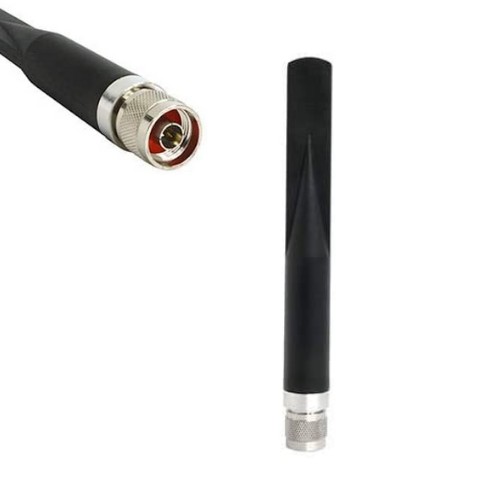
The ALFA Network AOA-915-5ACM is the compact N-male outdoor omni we already recommend for low Brazos Valley roofs and solar boxes. Pair it with Option 1 or Option 2. Its "5 dBi" label is optimistic, as our antenna upgrade guide explains, but it is a sturdy, honest outdoor antenna when you buy a genuine unit. Rokland also sells it (Rokland ALFA listing); it was $14.97 there when we checked. If you can mount higher and clear the trees, the Rokland 5.8 dBi outdoor omni kit ($49.97 to $74.97 depending on cable) is the taller option. Its title says N-male while its description says N-female, so let the included cable do the matching, and check the antenna end before buying a separate cable for it.
Best for: the first outdoor antenna on an eave, solar box, or low mast.
Trade-offs: N-male, so you need an SMA-to-N-female part. Counterfeits exist, so buy from the links here or another authorized seller.
Option 5: N-type lightning arrestor — for runs that enter a building

If coax runs from a roof antenna into a house, barn, or shop, put an arrestor in the line where it enters and bond it to a proper ground. The RAKwireless lightning arrestor (N-male to N-female, 0–2700 MHz, PID 910033), sold by Rokland, is a 50-ohm inline part. The listing gives power loss of 0.2 dB or less up to 2000 MHz and an IP67 rating. It was $24.97 at Rokland when we checked. Because it is N-male on one end and N-female on the other, it drops between an N-female cable end and an N-male antenna or jumper without adding another adapter.
Best for: any roof or mast install with coax entering a structure.
Trade-offs: an arrestor only helps if it is grounded well. Follow the maker's grounding guidance and your local electrical code. This is not electrical-code advice.
Option 6: Rokland RokTape — seal every outdoor joint

Water wicking into a connector is a slow way to lose a good antenna. Rokland RokTape is a 15-foot roll of self-fusing silicone tape that bonds to itself when you stretch it. Rokland's instructions say to stretch it to at least 200% for the first three overlaps. It was $6.97 when we checked. Wrap every outdoor N-type and SMA joint after you have tightened it and confirmed the node works.
Best for: every connector that lives outside, especially in Texas summer storms.
Trade-offs: you have to cut it off to service the joint, so test before you wrap.
Honorable mentions
A few more parts are worth knowing about. If your radio has an RP-SMA female jack and your antenna is SMA male, the reverse converter is the Rokland RP-SMA male to SMA female barrel ($6.97). For a short N-type jumper between an arrestor and an antenna, or out of an enclosure with an N bulkhead, the Rokland 3 ft N-male to N-female RFC-400 cable was $14.97. For bonding an arrestor to ground, Rokland sells 10-gauge solid bare copper grounding wire in lengths from 10 feet ($14.97) up to 50 feet.
What we would skip: mystery multi-adapter kits used as a permanent solution, thin RG-58 or RG-174 jumpers longer than a few inches on a rooftop run, and any N-type part that does not say 50 ohms.
Which should you buy?
Handheld or window node with an SMA whip: nothing. Screw it on, and make sure it is on the LoRa jack.
Old RP-SMA Helium antenna on a new SMA board: the SMA male to RP-SMA female barrel (Option 3).
ALFA or other N-male antenna right at the enclosure: the SMA male to N-female adapter (Option 1), plus RokTape.
Antenna a few feet above an eave or solar box: the shortest SMA-to-N-female low-loss cable that reaches (Option 2), plus RokTape.
Rooftop or barn mast with coax entering a building: keep the radio near the antenna if you can, use 400-grade cable for long runs, add the N-type arrestor at the entry point with a real ground, and tape every joint.
FAQ
What is the difference between SMA, RP-SMA, and N-type?
SMA and RP-SMA are the same small threaded connector with the center pin and socket swapped, so they do not mate without a converter. N-type is a larger, weatherproof-when-mated connector for outdoor antennas and thick coax. All three are 50-ohm in the versions used for LoRa, although N-type also comes in a 75-ohm variant to avoid.
Is my LoRa board SMA or RP-SMA?
Most LoRa boards and kits with an external jack use SMA female: outside threads with a center hole. Helium miners and most Wi-Fi gear use RP-SMA. Check the center of the jack rather than trusting a listing title.
Can I use an RP-SMA antenna on a MeshCore board?
Yes, with an SMA male to RP-SMA female barrel. Expect about 0.2 dB of loss per Rokland's listing. For new purchases, just buy an SMA antenna.
Do adapters hurt range?
A single quality adapter costs very little, about 0.2 dB per Rokland's listings. Chains of adapters and long runs of thin coax are what hurt. Times Microwave lists about 7.6 dB per 100 feet for LMR-240 and 3.9 dB per 100 feet for LMR-400 at 900 MHz.
Do I need a lightning arrestor for a MeshCore repeater?
If coax runs from an outdoor antenna into a building, an inline N-type arrestor bonded to a proper ground is good practice. A self-contained solar repeater with no cable entering a structure is a different situation. Either way, follow the arrestor maker's guidance and local code.
Does the connector choice depend on MeshCore or Meshtastic?
No. Both run on the same 915 MHz boards and use the same connectors. Brazos Valley Mesh runs MeshCore.
Getting on the Brazos Valley mesh
If you would rather skip the parts bin, our Pocket Mesh Node comes with an external 915 MHz antenna in the box. It is flashed with MeshCore or Meshtastic, your choice. If you're joining us around Bryan–College Station, we recommend MeshCore. The Brazos Valley Mesh shop also has a solar repeater mesh node for hosts with a good high spot. Buying parts anywhere is fine. Buying from us funds the local mesh, since proceeds go into repeaters and rooftop work around the valley.
Gear links
- SMA male to N-female adapter (Rokland)
- SMA male to N-female low-loss cable, 240/400 grade (Rokland)
- SMA male to RP-SMA female barrel (Rokland)
- RP-SMA male to SMA female barrel (Rokland)
- ALFA Network AOA-915-5ACM, also at Rokland
- Rokland 5.8 dBi outdoor omni kit
- RAKwireless N-type lightning arrestor (Rokland)
- 3 ft N-male to N-female RFC-400 cable (Rokland)
- 10-gauge bare copper grounding wire (Rokland)
- Rokland RokTape self-fusing silicone tape