Where to Put a MeshCore Repeater: Height and Line of Sight
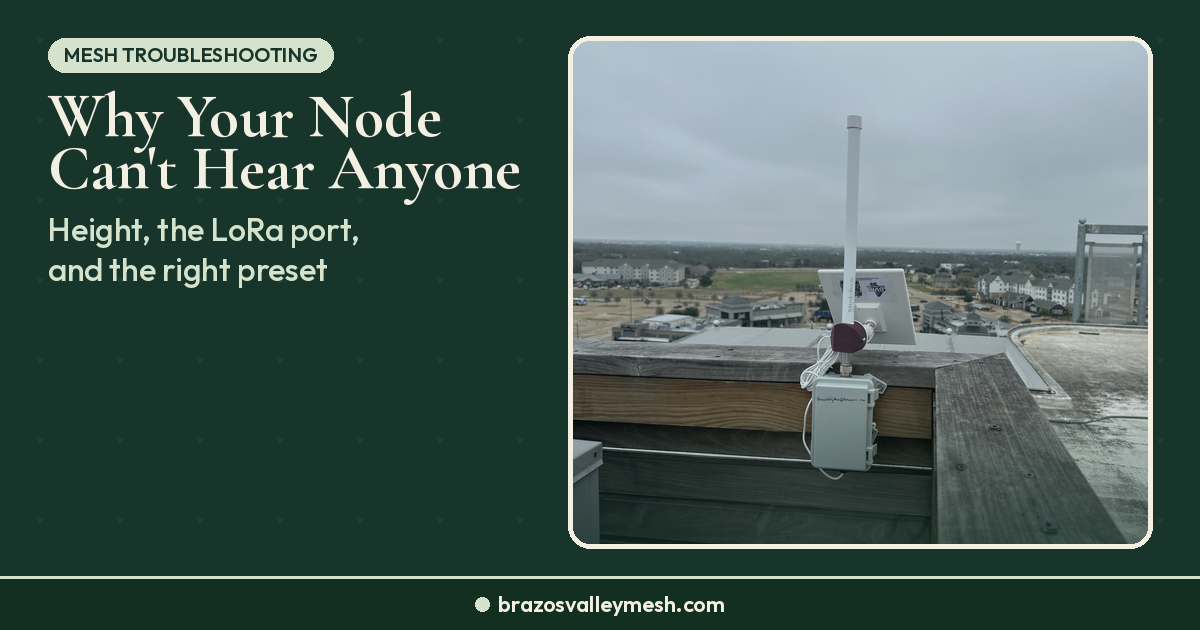
Where should you put a MeshCore repeater? Put the antenna — and preferably the whole node — as high and clear of trees and rooflines as you safely can. At 915 MHz LoRa, the path is mostly line of sight, so height beats extra watts.
Around Bryan–College Station, we see that every week: a pocket companion that barely works indoors suddenly gets heard repeats once a neighbor's node clears the trees. The MeshCore FAQ says the same thing in one line: place the repeater high above ground to extend the network's reach. We checked the placement advice below against that FAQ, the MeshCore SenseCAP solar guide, and our own BCS field notes on Nov 3, 2026.
Quick answer
- Height first. Get the antenna above the clutter you can see from the yard: neighboring roofs, dense oaks, metal sheds.
- Clear line of sight (LOS) beats power. Trees, buildings, and metal roofs weaken a 915 MHz path more than a few extra dB of transmit power can usually make up.
- Climb the siting ladder. Indoor window → eave/soffit → short mast or J-arm → tall mast/tower (only if you're allowed and can do it safely).
- Keep coax short. Put the radio near the antenna when you can; a long, skinny feedline can undo a good mount. We'll cover coax loss numbers in a later post.
- Flash repeater firmware for a fixed high node. Companions stay with people. See MeshCore repeater vs companion vs room server.
- Scout before you buy. Check the map and heard repeats first: how to find MeshCore repeaters near you.
Why line of sight matters at 915 MHz
LoRa at ~915 MHz (USA/Canada MeshCore uses 910.525 MHz, SF7, BW62.5, CR5 on the recommended preset) behaves more like a flashlight with soft edges than like FM radio that wraps around every hill. It can sneak through some walls and foliage better than Wi-Fi, but the path that actually works for a town mesh is still mostly a clear shot between antennas.
The MeshCore blog's SenseCAP P1-Pro guide puts it plainly: buildings, hills, dense trees, and metal structures all weaken the signal, so try mounting higher and clearing the path before you swap the antenna. Their open-field ~9 km test result is called out as a best-case clear LOS number, not a promise for a BCS neighborhood full of live oaks.
So when someone asks "where to put a MeshCore repeater," the honest answer is: wherever the antenna can see the most of the mesh you care about — not wherever the outlet or the attic hatch happens to be.
The siting ladder (cheapest and easiest first)
Work up this list. Stop when your companion at home starts getting reliable heard repeats from the new node, or when you hit a landlord, HOA, or safety limit.
1. Indoor window (proof of concept)
Park a temporary node (even a companion on a USB brick) at an upstairs window on the side facing the nearest known repeater or the gap you want to cover. Keep the antenna vertical and clear of the window frame and the AC unit. This is a test, not a permanent site. Walls, Low-E glass, and foil-backed insulation can still kill the path. Use it to decide whether height on this property is worth the hassle.
2. Eave, soffit, or porch peak
A mount outside the wall, under the overhang, often clears one story of clutter without a roof walk. Keep the antenna tip below the drip edge if wind load worries you, but get it out of the attic and away from HVAC metal. This is the most common "good enough" fixed spot on single-story BCS houses.
3. Short mast or J-arm on roof, chimney, or pole
A 12-inch universal pole mast (Rokland) or similar J-arm lifts a small outdoor omni like the ALFA AOA-915-5ACM (Rokland) clear of the ridge and the nearest trees. Our 915 MHz antenna upgrade guide and handheld vs rooftop antenna post cover which stick to put up there. Stay legal: roof work, fall protection, and landlord permission are on you.
4. Tall mast, tower, or barn peak
This gives the best radio results, with the highest cost and risk. Only chase this after you've confirmed the lower rungs aren't enough, and only with property-owner buy-in. If you don't own the building, our hosting page is the conversation starter for property owners — small weatherproof box, no building cable required for many solar setups, removable when asked.
What to clear (and what usually blocks BCS links)
Walk the intended path in your head, then with your eyes:
- Trees at antenna height. Live oaks and pecan canopies eat 915 MHz. Getting the tip above the local canopy beats a louder radio under it.
- Metal roofs, HVAC, and gutters. Keep the antenna away from large metal sheets and don't strap it against a duct.
- Neighboring two-stories and townhomes. One house between you and the far node can matter more than the map distance.
- Indoor clutter. Routers, aquariums, foil insulation, and appliance walls are bad neighbors for a desk "repeater."
Our older antennas and rooftops note is still the local picture of why a ground-floor node looks deaf on a flat Brazos Valley map.
Coax: Prefer the radio box close to the antenna so the feedline stays short. A long run of thin coax can throw away the gain you just bought. Exact loss tables will come in a later coax post; for now, "antenna on the roof, radio in the garage on 50 feet of bargain cable" fails the smell test. Connector types (SMA / RP-SMA / N) are covered in SMA vs RP-SMA vs N-type.
Power, shade, and lightning when you're above the roofline
Height solves RF. Heat and storms try to undo the install.
- Solar box off the hot roof deck when you can. Panel in sun, electronics in shade or a light-colored vented enclosure. Details in Texas-proofing a solar repeater and solar mesh node for summer.
- Soak-test on the ground first. Flash MeshCore repeater firmware, set USA/Canada (Recommended), change the default admin password (`password`), set lat/lon if you want the map pin, and prove heard repeats before you climb.
- Lightning path for mast / long coax. For antennas above the roofline, a feedline arrestor and a proper ground are prudent engineering in thunderstorm country. They're not a substitute for a qualified electrician. We use parts like the RAK N-male to N-female lightning arrestor (Rokland) and 10-gauge bare copper ground wire (Rokland). This is high-level caution, not electrical-code or legal advice.
What a well-placed high node actually changes on a local mesh is the story in what a rooftop repeater changes: companions stay in pockets; the roof does the long hops.
Companion vs repeater for that first fixed node
If the board is staying put at height to grow coverage, flash repeater firmware. MeshCore companions do not repeat other people's traffic on the USA/Canada recommended preset. That's intentional. Room servers are a message board, not a coverage node; on 1.18.0 firmware they ship with repeating off and no longer accept `set repeat on`. Full role split: repeater vs companion vs room server.
 Ready-made outdoor options people around here look at when DIY isn't the goal: RAK WisMesh Repeater Mini (Rokland). Sold out at Rokland right now? Alternatives: SenseCAP P1-Pro for MeshCore (Amazon) ($139.99; Seeed Studio $100.99 as of Nov 17, 2026), SenseCAP P1-Pro for Meshtastic (Amazon) ($139.99; Seeed Studio $101.99 as of Nov 17, 2026), or the KEEPTEEN D5L-R1 5W solar repeater with RAK19007 + RAK4631 (Amazon, third-party seller) ($119). Site height still matters more than which kit you pick. Check current prices and stock before you buy.
Scout first — then buy hardware
Don't order a mast because the map looks empty.
- Open map.meshcore.io (or Internet Map in the app).
- Let your companion listen on USA/Canada (Recommended).
- Prove heard repeats from the spots you care about.
That whole loop is in how to find MeshCore repeaters near you. Heard repeats from the couch? You may not need a repeater at all. Heard repeats only from the upstairs window? Work on antenna and height. Nothing nearby? Then you're starting coverage, and this siting checklist is your next read, not a 1-watt impulse buy. For power vs placement, see do you need a 1-watt mesh node.
FAQ
Where should I put a MeshCore repeater?
As high and as clear of trees, roofs, and metal as you can safely and legally manage. MeshCore's FAQ tells you to place a repeater high above ground; their solar guide adds that height and open LOS often beat an antenna swap. Start at a window or eave, then climb the siting ladder only as far as the mesh needs.
Is an attic better than a roof for a MeshCore repeater?
Usually no. An attic is dry and easy, but foil insulation, HVAC metal, and the roof deck itself sit in the path. Use the attic only as a temporary test or when outdoor mounting is impossible. An outdoor eave or short mast is the better permanent answer on most BCS houses.
Do I need a 1-watt node if I get the repeater up high?
Usually not for a first fixed node. Height and a clear antenna help both transmit and receive. Add power later only if the link is still marginal after real height and a proper outdoor antenna. Details: do you need a 1-watt mesh node.
How high is high enough?
High enough that the antenna clears the local clutter toward the mesh you care about — often just above the nearest tree line or ridge, not "as tall as a cell tower." Test with a temporary mount and heard repeats before you commit to a tall mast.
What about HOA, landlord, or rental rules?
Ask first. Many sites only need a small weatherproof box and a short mast; some allow nothing visible. If you own or manage a building and want to host coverage for the neighborhood, start at our hosting page. We can't give HOA or lease advice, so get permission in writing when it matters.
Should the solar box sit on the roof with the antenna?
The antenna wants height and sky. The electronics want shade and sane temperatures. Separating them with a short coax run is often better than cooking the radio on a dark shingle roof. See Texas-proofing.
Getting on the Brazos Valley mesh
Need a companion while you scout sites? Our Pocket Mesh Node is flashed with MeshCore or Meshtastic, your choice. If you're joining us around Bryan–College Station, we recommend MeshCore. Buying gear anywhere is fine. Buying from the Brazos Valley Mesh shop helps fund the local mesh. Property owners who can offer a high, clear spot should look at our hosting page before buying anything. Sometimes the best "where to put it" answer is a neighbor's roof with a hosting agreement.