Mesh Node Battery: 18650 vs LiFePO4 for Cold Weather
For most MeshCore and Meshtastic pocket nodes, keep the battery pack the maker ships. For DIY solar or fixed 915 MHz outdoor nodes, pick chemistry for the charge-temperature window and a sane BMS—not the biggest mAh number on the listing.
Winter planning is a good time to get that straight. Around Bryan–College Station, roofs and eaves still see overnight lows near freezing a few times a year, even when daytime highs look mild. Heat remains the bigger long-term risk for outdoor boxes here (see our Texas heat, humidity, and lightning guide), but cold charging is the claim that will quietly kill cells if you ignore the datasheet.
Quick answer
- Pocket / companion: use the included LiPo or holder, keep polarity correct, and charge indoors or on USB as the maker intended.
- DIY solar / rooftop repeater: parallel 18650 Li-ion is the common MeshCore path. LiFePO4 can make sense for larger packs if the charger and BMS match that chemistry.
- Cold rule of thumb: do not charge standard lithium cells below about 0 °C (32 °F) unless the cell datasheet and charge controller explicitly allow it. Discharge can often go colder; charge is the hard limit.
- Local reality: BCS winters are mild vs the Upper Midwest, but a black roof box on a clear night can still drop near freezing. Plan a low-temp charge cutoff if the pack sits outdoors all season.
18650 Li-ion vs LiFePO4 for mesh nodes
18650 Li-ion (NMC / NCA-class cells) is what most DIY MeshCore and Meshtastic solar builds use today. Nominal voltage is about 3.6–3.7 V per cell, charge to 4.2 V, and energy density is high for a small box. Typical cells we see in local builds:
- NCR18650GA — Panasonic/Sanyo high-capacity cell; datasheet charge window +10 °C to +45 °C, discharge about −20 °C to +60 °C, typical capacity about 3450 mAh. Rokland’s page may show Panasonic-label stock when the Sanyo-label pack is sold out—same cell chemistry; check the live listing.
- Molicel P30B — high-drain 18650; datasheet typical capacity 3000 mAh, charge 0 °C to 60 °C, discharge about −40 °C to 60 °C. Useful when you want more current margin; not automatically “better in winter” than a high-capacity GA cell for a sleepy LoRa repeater.
LiFePO4 (LFP) sits at about 3.2 V nominal per cell and usually charges to about 3.65 V, not 4.2 V. Cycle life and thermal stability are often better for larger stationary packs, and cold discharge tolerance is frequently stronger than pouch LiPo. That does not mean you can charge standard LiFePO4 below freezing. Mesh America's cold-weather guide and multiple LFP pack datasheets still put charge near 0 °C to ~45–55 °C unless the pack is a heated / wide-temp design with a BMS that enforces the cutoff. LiFePO4 also needs a charger and BMS matched to LFP voltages—do not drop LFP cells into a 4.2 V Li-ion charge path and call it done.
Bottom line for BCS DIY solar: stick with known 18650 Li-ion cells and a 1S parallel pack on boards like the RAK19003 unless you are deliberately building an LFP system with the right charge profile. Our DIY solar MeshCore repeater parts guide walks the 2× / 6× 18650 path.
Protected vs unprotected cells (and holders)
- Unprotected 18650 cells are bare cells. Safe use depends on an external protection module / BMS for over-charge, over-discharge, and short-circuit limits.
- Protected cells add a small PCB on the negative end. They are longer than bare cells, so verify the holder length before you buy a “protected” pack for a tight tube.
- Parallel holders for solar nodes should be true 1S parallel (positives tied, negatives tied)—not series—unless you redesigned the whole charge path. Prefer a wired parallel holder such as the ACEIRMC 18650 dual parallel holder 6-pack when you need replacements. Confirm the holder is wired in parallel before you buy—Amazon listings sometimes market the same SKU for “Parallel or Series Circuit” projects—and recheck the page because stock moves.
- Polarity mistakes are the fast way to smoke a board. Flat LiPo packs with JST PH 2.0 plugs are convenient for companion nodes—for example the PKCELL 803860 2000 mAh LiPo—but red/black cavity order is not universal. Verify against the board silk or RAK's battery-connector diagram before you plug in.
No lithium chemistry is “fireproof.” Treat cells as energy storage that needs the right charger, temperature window, and mechanical protection.
Cold-weather charging basics
Manufacturer datasheets, not forum folklore, set the window. Many 18650 Li-ion cells list charge from 0 °C to 45 °C and discharge from about −20 °C to 60 °C, so you stop charging near freezing. The NCR18650GA is stricter on the low end: charge 10 °C to 45 °C, discharge about −20 °C to 60 °C. The GA datasheet allows 0–10 °C only at reduced current; treat 10 °C as the safe full-rate floor. The Molicel P30B lists charge 0 °C to 60 °C and discharge about −40 °C to 60 °C, still with no sub-zero charge. Common LiFePO4 packs usually charge from about 0 °C to 45–55 °C; discharge can go colder, but they need an LFP charger and BMS, and they still don't get a free cold-charge pass.
Why outdoor solar nodes care: a sunny winter morning can push charge current into a pack that spent the night below the charge floor. Lithium plating on the anode is the failure mode people worry about—capacity loss and, in bad cases, internal shorts. Label any “0.05C is fine below freezing” tip as unverified community lore. We are not endorsing it here.
Community tip (verify before you copy it): some Meshtastic builders put a KSD301-style bimetal thermostat in series with the solar input. A normally-open ~0 °C part stays open when the cell is too cold and closes once the pack warms enough to allow charging. KSD301 devices are snap-disc thermal switches sold as normally-open or normally-closed, with various trip temperatures. They are not a full BMS, not magic, and ratings on cheap listings are often AC-oriented, so check the part, mount the sensing face on the cell (not just enclosure air), and treat this as a supplemental cutoff. A charger with a proper NTC / low-temp charge inhibit is the cleaner long-term fix. Boards without a battery temperature cutoff (including common RAK19003 DIY paths) need you to add that discipline yourself.
Texas winters vs northern cold
Bryan–College Station is not Fargo. Multi-week deep freezes are rare. Still:
- Overnight roof and eave boxes can sit near 0 °C after a clear front.
- Daytime solar can resume charging while the pack is still cold.
- Summer heat inside a dark sealed box is usually the bigger local killer—venting, color, and drainage matter more than winter folklore for most BCS installs. Pair this post with solar mesh node summer planning and the Texas-proofing guide.
If you only host a pocket node, charge it indoors and skip the thermostat hobby. If you hang a fixed outdoor repeater, size reserve for short winter days, keep the pack chemistry and charger matched, and add a real low-temp charge cutoff when the enclosure can freeze.
What to buy (and when to skip DIY)
- Starting handheld: a ready node such as the Wio Tracker L1 Pro (Seeed Studio) ships with a matched pack—follow the maker’s charge guidance.
- Turnkey outdoor: the RAK WisMesh Repeater Mini packages panel, battery, and enclosure when you would rather not design a pack. Sold out at Rokland right now? Alternatives: SenseCAP P1-Pro for MeshCore (Amazon) ($139.99; Seeed Studio $100.99 as of Nov 17, 2026), SenseCAP P1-Pro for Meshtastic (Amazon) ($139.99; Seeed Studio $101.99 as of Nov 17, 2026), or the KEEPTEEN D5L-R1 5W solar repeater with RAK19007 + RAK4631 (Amazon, third-party seller) ($119). Height still beats heroic mAh—see what a rooftop repeater changes and when 1 watt helps.
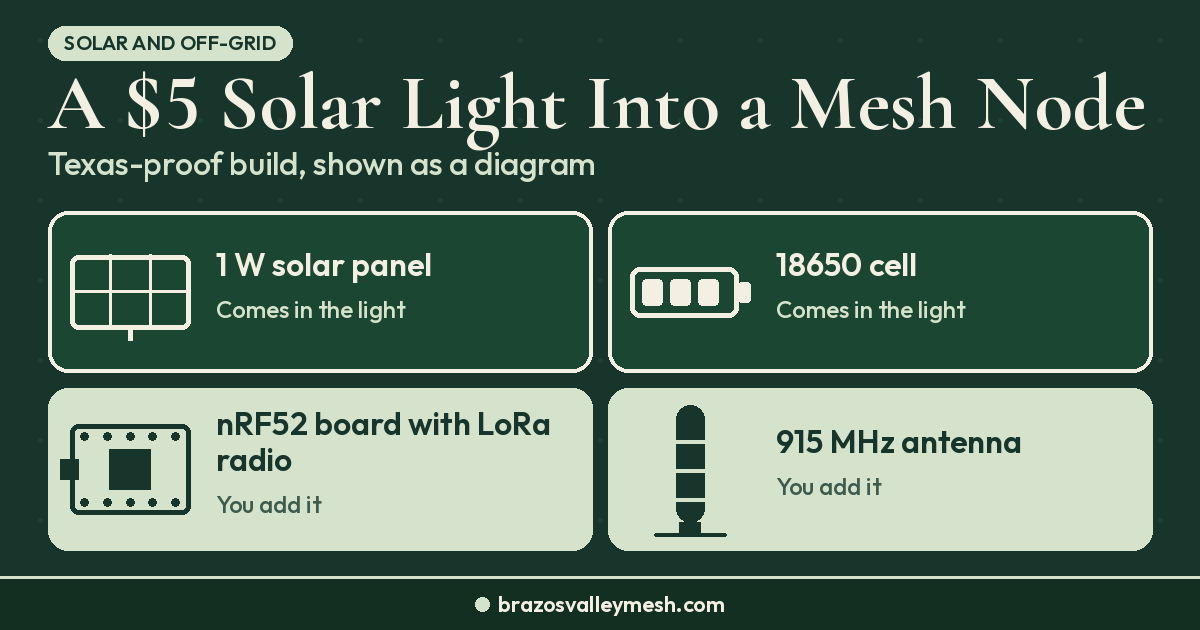
- DIY solar 18650: follow the RAK19003 build, buy known cells, parallel holders, and a 1S protection path.
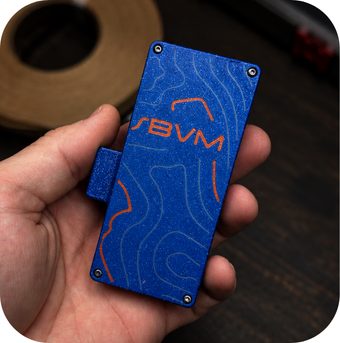
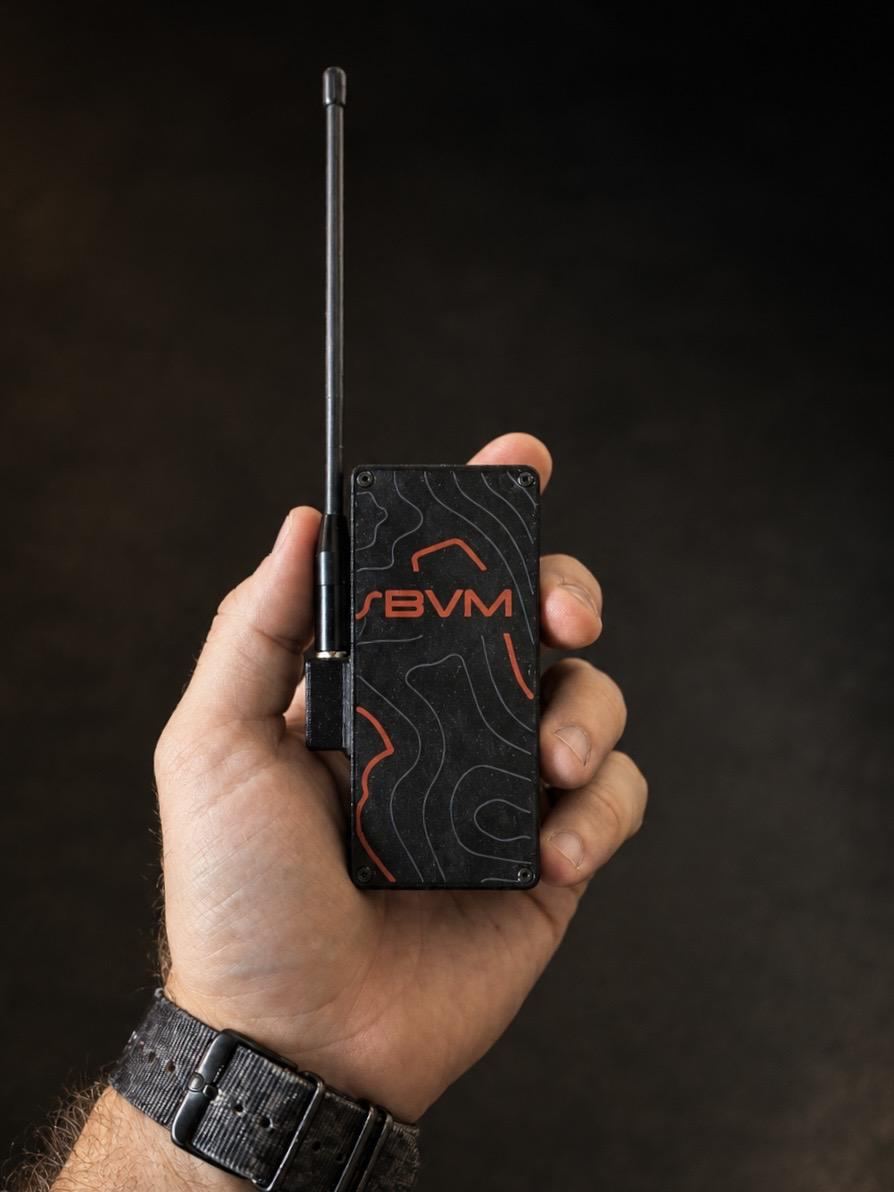
Need a ready companion while you plan solar? Our Pocket Mesh Node is flashed with MeshCore or Meshtastic, your choice. If you're joining us around Bryan–College Station, we recommend MeshCore. For a fixed outdoor pack without the soldering, see the shop solar repeater. Buying gear anywhere is fine. Buying from the Brazos Valley Mesh shop helps fund the local mesh.
FAQ
What mesh node battery should I use for Meshtastic or MeshCore?
For pocket nodes, keep the maker’s pack. For DIY solar or fixed 915 MHz outdoor nodes, prefer known 18650 Li-ion cells (or a purpose-built LiFePO4 pack with a matching charger/BMS), size for reserve instead of max mAh marketing, and do not charge below the datasheet floor—often about 0 °C, or 10 °C on cells like the NCR18650GA.
Can I charge 18650 mesh batteries below freezing?
Usually no. Many 18650 datasheets list charge from 0 °C to 45 °C; the NCR18650GA datasheet starts charge at 10 °C. Discharge can go colder. Outdoor solar nodes need a low-temp charge cutoff or a heated / wide-temp pack if nights freeze.
Is LiFePO4 better than 18650 Li-ion for cold mesh nodes?
LiFePO4 can be stronger for cold discharge and cycle life in larger packs, but standard LFP still should not be charged below about 0 °C unless the datasheet and BMS say otherwise. It also needs the correct charge voltage. It is not a drop-in “winter miracle” for a 4.2 V Li-ion board.
Do I need protected 18650 cells for a DIY solar MeshCore repeater?
You need protection somewhere—on the cell or in an external 1S BMS / protection module. Unprotected cells in a parallel holder without a protection path are a bad idea. Match holder length if you buy protected cells.
Are Bryan–College Station winters cold enough to worry about?
Mild compared with northern states, but roof boxes can still get near freezing overnight. Heat and humidity usually hurt BCS outdoor nodes more over a year; still treat cold charge as a hard electrical limit, not optional folklore.