915 MHz Coax Loss: When a Longer Cable Hurts Your LoRa Node
How much does coax loss matter at 915 MHz? On a MeshCore or Meshtastic node, a few feet of decent cable cost almost nothing, but 25 to 50 feet of thin coax can throw away more signal than a better antenna gains you. Short runs win.
That's the pattern we keep seeing around Bryan–College Station. Someone buys a good outdoor antenna, mounts it on the roof, runs a long cheap cable down to a radio in the garage, and ends up hearing about as much as before. The antenna was fine. The cable ate the upgrade.
This guide shows how to read a coax loss spec, what common cables actually cost you at 915 MHz, and when to move the radio instead of buying more cable. Cable figures come from manufacturer datasheets, and Rokland prices were checked on Nov 17, 2026. We have not lab-measured these cables ourselves.
The short answer
- Under about 3 feet: almost any 50-ohm cable sold for LoRa is fine, including the thin pigtail inside an enclosure.
- About 3 to 15 feet: use 240-grade low-loss cable (LMR-240 class). Expect well under 1.5 dB of loss.
- About 15 to 50 feet: step up to 400-grade (LMR-400 class), or better yet, rethink the layout.
- Long run to a radio indoors: put the radio in a weatherproof box near the antenna and run power or USB down instead of RF. That usually beats any coax.
- Never: a long run of RG-58 or thin RG-178 between a good antenna and the radio.
Decibels in plain English
Coax loss is listed in decibels (dB). A few numbers make the rest of this guide easy to read:
- 1 dB of loss leaves about 79% of your signal.
- 3 dB leaves about half.
- 6 dB leaves about a quarter.
- 10 dB leaves about a tenth.
Cable loss works in both directions. The same cable that weakens your transmit signal also weakens every packet you receive from the rest of the mesh. In open, line-of-sight conditions, every 6 dB you lose roughly halves your free-space range. Real terrain, trees, and buildings make that messier, but the direction never changes: loss costs reach.
That's why an antenna upgrade and a cable choice should be planned together. Our 915 MHz antenna upgrade guide covers the antenna side, and many marketed gain numbers are optimistic anyway. Losing 3 dB in cable can wipe out most of what a modest outdoor omni adds.
How to read a coax loss spec
Cable datasheets usually list attenuation in dB per 100 feet (or per 100 meters) at a handful of frequencies. Here's how to use one:
- Find the 900 MHz row. Most datasheets do not list 915 MHz exactly, and the difference is tiny. Using Times Microwave's own attenuation formula, LMR-400 works out to about 3.94 dB per 100 feet at 915 MHz versus 3.9 at 900 MHz.
- Scale to your length. Loss is linear with length. Divide the per-100-feet number by 100, then multiply by your run in feet.
- Check "typical" versus "maximum." Times lists typical values. Belden's RG-178 sheet lists nominal values. Either way, treat the result as a ballpark, not a promise.
- Add the connectors and adapters. Each joint costs a little. Rokland lists about 0.2 dB for its single adapters, which we covered in our SMA vs RP-SMA vs N-type connector guide. One is fine. A chain of three plus a jumper adds up.
- Don't trust length alone if the seller will not name the cable. A listing that says "low loss" with no cable type or dB figure tells you nothing.
What common cables cost at 915 MHz
These are 900 MHz datasheet figures, scaled to lengths people actually buy. They are cable-only and do not include connectors.
LMR-400 (Times Microwave datasheet: 3.9 dB per 100 ft at 900 MHz). Thick, stiff, and the go-to for real runs. A 3-foot jumper costs about 0.1 dB. 25 feet costs about 1 dB. 50 feet costs about 2 dB.
LMR-240 (Times Microwave datasheet: 7.6 dB per 100 ft at 900 MHz). Thinner and easier to route. A 20-inch jumper costs about 0.1 dB. 6 feet costs about 0.5 dB. 15 feet costs about 1.1 dB. 25 feet costs about 1.9 dB, and 50 feet about 3.8 dB, which throws away more than half your signal.
RG-58 (Belden 8240 datasheet: 13.7 dB per 100 ft at 900 MHz). Common and cheap, and fine for a short jumper. 25 feet costs about 3.4 dB. 50 feet costs about 6.9 dB, which leaves you roughly a fifth of your signal. That's more than the gain of almost any outdoor omni we would recommend.
RG-178 (Belden 83265 datasheet: 42.5 dB per 100 ft nominal at 900 MHz; Huber+Suhner lists about 1.5 dB per meter typical). That's the skinny pigtail cable inside many enclosures, often U.FL to SMA or U.FL to N. Call it roughly 0.4 to 0.5 dB per foot. A 6-inch pigtail costs about 0.2 dB, and a 12-inch one about 0.5 dB. That's fine. Ten feet of RG-178 would cost over 4 dB, so keep it inside the box.
A note on brands: Times Microwave makes LMR. Many LoRa sellers, including Rokland, sell "240 grade" and "400 grade" equivalents. That's normal, but it means the Times figures are a guide, not a guarantee, for those cables.
When a longer cable hurts: three real layouts
Handheld or pocket node. No coax at all. The antenna screws onto the radio. If you want a better whip, see our handheld vs rooftop antenna guide.
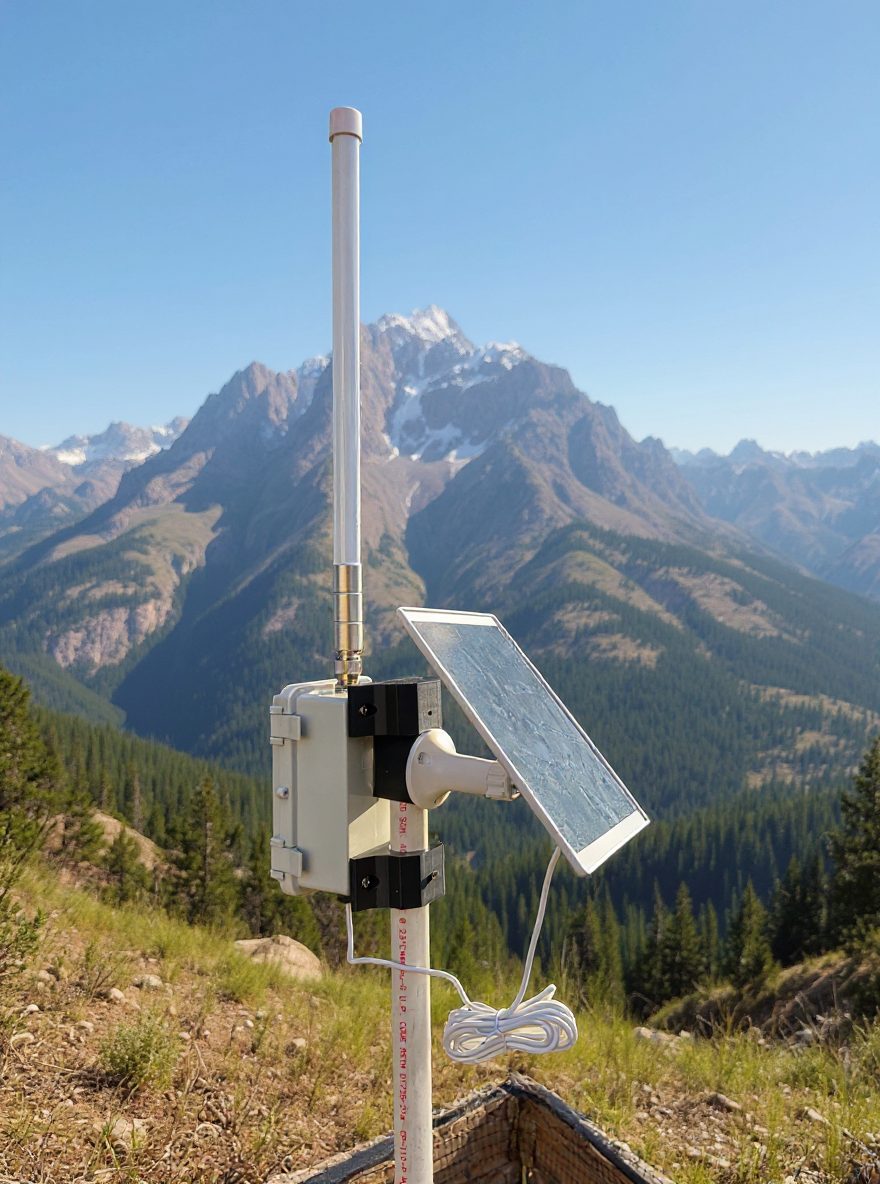
Eave node or solar box. The radio sits in an enclosure, and the antenna sits on top of it or a foot or two above. Use a short internal pigtail and, if needed, a short 240-grade jumper. Total loss should stay well under 1 dB. This is the layout in our DIY solar MeshCore repeater build.
Roof antenna with the radio indoors. This is where cable hurts. A 25-foot run of 400-grade cable costs about 1 dB, which is acceptable. A 50-foot run of RG-58 costs about 7 dB, which is not. If the run is long, the better fix is usually to move the radio up to the antenna in a weatherproof box and run power down to it. Low-voltage DC or USB does not care about 915 MHz loss. Our guide to why your mesh node can't hear anyone yet explains why that extra height matters more than almost anything else.
Do not "fix" cable loss with more power
It's tempting to buy a 1-watt radio to make up for a long cable. That only helps your transmit side. The cable still eats incoming packets on the way back down, so other nodes may hear you while you still miss their replies. Fix the cable first. If you still want more power after that, read do you need a 1-watt mesh node before you buy.
What we would buy
These are the parts we would actually reach for, starting with the shortest length that reaches.
Short SMA-to-N jumper or extension (Rokland). The Rokland SMA male to N-female low-loss cable comes in many lengths. On Nov 17, 2026, the 12-inch and 20-inch 240-grade versions were $10.97, the 6-foot 240-grade was $19.97, the 10-foot 240-grade was $23.97, the 3-foot 400-grade was $12.97, and the 25-foot 400-grade was $47.97, all in stock. The 50-foot 400-grade was out of stock. Buy the shortest length that reaches, because coiled-up extra cable still costs loss.
N-to-N jumper out of an enclosure or arrestor (Rokland). The Rokland 3 ft N-male to N-female RFC-400 cable was $14.97 and in stock on Nov 17, 2026.
Skip the cable entirely (Rokland). If the antenna is N-male and sits right on the box, the Rokland SMA male to N-female adapter ($5.97, in stock) is the lowest-loss option of all.
Internal pigtails (Amazon or Rokland). For a board with a U.FL (IPEX/MHF1) antenna connector, keep the pigtail short. Options include the U.FL to N-female bulkhead pigtail, 6 in, 2-pack and the TUOLNK U.FL to SMA male pigtail, 12 in, 5-pack on Amazon. Rokland's U.FL to N-female bulkhead pigtail had the 12-inch length in stock at $6.47 on Nov 17, 2026; the 4-inch and 8-inch were out. Check the connector type before you buy. U.FL/MHF1 and the smaller MHF4 are not interchangeable.
Coax entering a building (Rokland). If a run comes off the roof and into a house, barn, or shop, add the RAKwireless N-type lightning arrestor ($24.97, in stock on Nov 17, 2026) at the entry point and bond it to a proper ground. Our heat, humidity, and lightning guide covers the rest of that install.
What we would skip: unnamed "low loss" cable with no dB figure, long RG-58 runs to a roof antenna, and extra adapters stacked to make mismatched parts fit.
Rather skip the cable math?
Our Pocket Mesh Node is flashed with MeshCore or Meshtastic, your choice. If you're joining us around Bryan–College Station, we recommend MeshCore. It needs no coax at all. For a fixed outdoor node with the radio already at the antenna, see the shop solar repeater. If you have a tall spot and want to help coverage, read about hosting a node. Buying gear anywhere is fine. Buying from the Brazos Valley Mesh shop helps fund the local mesh.
FAQ
How much coax loss is acceptable at 915 MHz?
For most MeshCore and Meshtastic nodes, aim to keep total cable and connector loss under about 1 to 2 dB. A few feet of 240-grade cable or 25 feet of 400-grade cable fits that budget. Once you pass about 3 dB, you are throwing away half your signal in both directions.
Is LMR-240 or LMR-400 better for a LoRa antenna?
LMR-400 has about half the loss per foot (3.9 versus 7.6 dB per 100 feet at 900 MHz, per Times Microwave). For runs of a few feet, LMR-240 is easier to route and the difference is a fraction of a dB. Past about 15 to 25 feet, use 400-grade.
Does a longer antenna cable reduce MeshCore or Meshtastic range?
Yes. Every foot adds loss, and that loss applies to both transmit and receive. In open line-of-sight conditions, about 6 dB of extra loss roughly halves free-space range. Coiling up extra cable does not help.
Can I use RG-58 for a 915 MHz mesh antenna?
For a short jumper, yes. Belden lists RG-58 at about 13.7 dB per 100 feet at 900 MHz, so a 50-foot run costs nearly 7 dB. For anything long, use 400-grade cable or move the radio closer to the antenna.
Is it better to move the radio closer to the antenna?
Usually, yes. A weatherproof box at the mast with a short jumper, powered by a DC or USB run, avoids most RF loss. That's how most solar repeaters are built.