90-Day Grid-Down Rumor: How a LoRa Mesh Keeps You Talking
A 90-day grid-down is a rumor, not a forecast. If you want a plan for a long outage, start with layers: a 915 MHz LoRa mesh like MeshCore for local text, GMRS or ham for voice, and NOAA Weather Radio for alerts, because cell and internet can fade within hours to days. Below: what's confirmed this week, what's rumor, and what works in Bryan–College Station.
A quick note on tone. We build a local mesh, and we'd rather you finish this post calmer than you started it. Nothing below says a 90-day blackout is coming. When the power does go out (and in Texas it eventually does), the people who already know how to reach their neighbors have a much easier time.
What's confirmed vs. what's circulating (as of Nov 18, 2026)
If your feed has been full of #GridDown, "cyberattack" and "90-day blackout" posts, here's the short version. We checked each item against primary sources and fact-checkers on Nov 18, 2026.
Confirmed:
- No cyberattack has been confirmed behind this week's outages. The FAA's nationwide ground stop on Nov 13 traced to unstable legacy network equipment after a flood of data, with possible sources at an Amarillo, Texas radar site and an El Dorado, Arkansas radio site. The FAA says it has no indication this was a cyberattack, and DHS said it saw zero evidence of one.
- Apple says its Nov 17 outage came from an internal update. Apple said it was not a cyberattack. The NSA described its network trouble as scheduled routine maintenance. The Director of National Intelligence said on CNBC that it was not a coordinated nation-state effort. Some skeptics and lawmakers still want more transparency, which is fair.
- The Nov 17 "blackout" was an Emergency Alert System test. FEMA and the FCC ran a one-minute test on TV and radio, and FEMA said beforehand: "No blackouts, no secret emergencies." PolitiFact rated the 90-day blackout claim False, and Snopes traced how the rumor spread.
- The "90 days" number has a real source, with a catch. The Pentagon's FORTRESS initiative reportedly aims to let major bases run at least 90 days without civilian power, fuel or water. That's a military resilience standard, not a forecast of a civilian outage. Snopes notes the 90-day figure came through news reporting rather than an explicit Pentagon confirmation.
- Cyberattacks on energy systems are real, but a U.S. grid blackout from one hasn't happened. CISA, NSA, FBI, DOE and EPA warned in August that attackers are targeting internet-exposed industrial controllers. A suspected Iran-linked attack shut down a small UK generator, and the UK government said the wider system was never at risk. Ukraine's 2015 attack cut power to roughly 225,000 customers for hours, and Quartz notes no confirmed cyber-caused blackout has occurred in the U.S.
Circulating, but unsupported by any source we could find:
- A coming "90-day blackout" starting Nov 17, or after the EAS test.
- "False flag," "deep state," "cyber Pearl Harbor," and "digital armageddon" framings of the outages. These come from copy-paste posts, not from reporting.
- Claims that continuity-of-government (COG) plans were activated or that the military has taken control. We found no official source for either.
- Old clips of conference speakers warning about a cyberattack, shared as if they were new.
- A viral map of "90-day grid collapse" survival odds. We couldn't find a government source behind it, so treat it as an opinion graphic.
The terms are worth knowing, because they're what people are searching. A zero-day exploit is a software flaw the vendor doesn't know about yet, and it's a real thing, but nobody has linked one to this week's outages. Critical infrastructure means systems like power, water and communications. A black swan event is a rare shock nobody planned for. Grid down simply means the electric grid isn't delivering power. The useful question is the same whether the cause is a storm, a bad software update, or an attack: what do you do when you can't call anyone?
Is Texas or the Brazos Valley affected?
Not as far as we can tell. As of Nov 18, ERCOT's operations messages showed routine equipment notices and no emergency declaration, and a third-party outage tracker showed well under 0.01% of Texas customers without power that morning. We found no reports of a Bryan–College Station outage tied to any of this week's events. ERCOT covers about 90% of Texas' electric load, and it just added text-message alerts to its notification system, which is worth signing up for.
Texas does have its own recent proof that long outages happen without any attacker. During Winter Storm Uri in February 2021, a University of Houston survey found 69% of Texans lost power, 47% lost cell service and 71% lost internet. The average power disruption was 42 hours. Bryan–College Station had rolling outages too. That's a multi-day event, not a 90-day one, but it's the same failure chain, just shorter.
Why cell, internet and repeaters fail in a long outage
Phones feel like they work without the grid, but they depend on a chain of powered equipment.
- Cell sites run on batteries first. Trade reporting puts typical cell-site battery reserve at about two to four hours, with diesel generators extending that to several days if fuel keeps arriving. According to that article, courts sided with carriers after the FCC ordered minimum backup power following Hurricane Katrina, so carriers decide their own reserves. The article is from 2020, so treat the hours as typical, not guaranteed.
- Real storms show the limit. After Hurricane Laura in 2020, FCC data showed 707 of 4,640 cell sites in the affected Louisiana parishes out of service on Aug 28, and 339 of them were down for lack of power. A tally of the FCC's daily reports still showed 254 sites out on Aug 31. At its peak, Superstorm Sandy in 2012 disabled about 25% of cell sites in the affected region, and FCC officials said at the time that many sites were running out of backup power. Real storms have taken cell sites offline when batteries or generator fuel ran out, sometimes for days.
- Congestion hits first. Even when towers stay up, everyone calling at once can make calls and texts crawl.
- Home internet needs power at both ends. Your router needs electricity, and so do the neighborhood equipment and the provider's network behind it.
- Repeaters of every kind need power. That includes radio repeaters. A mains-powered repeater goes down with the grid unless it has a battery or solar backup.
- Everything else leans on communications too. Ready.gov notes that outages can disrupt communications, water and transportation, and close banks, ATMs and gas stations.
In a 90-day scenario, nobody can promise how long the phone network would last, and we won't pretend to. The practical takeaway: plan as if cell and internet may be unreliable for much of a long outage. Anything better is a bonus.
What still works when cell and internet don't
No single tool covers everything. These are the layers we'd stack.
1. A LoRa mesh for local text (MeshCore or Meshtastic, your choice). LoRa is a low-power radio technique, and on 915 MHz in the U.S. it's license-free for normal use. A mesh relays short text messages from radio to radio with no tower and no internet. Around Bryan–College Station, we recommend MeshCore, since that's what the local repeaters run. Our MeshCore vs Meshtastic comparison explains the difference, and Mesh Network 101 covers how the relaying works.
2. FRS and GMRS for local voice. FRS radios are license-free. GMRS needs an FCC license. It costs $35, lasts ten years and covers your immediate family, and requires no exam. The FCC says a GMRS user can expect one to twenty-five miles depending on the station, terrain and repeater use, and repeaters can't be linked over the internet.
3. Ham radio, including HF, for the long haul. ARRL notes that amateur operators can communicate across town or around the world with no internet or cell network, and that hams helped during 9/11 and Hurricane Katrina. You need an FCC license, and study materials usually run under $40. If you want regional or statewide reach, HF is the layer for that. Technician licenses get limited HF privileges, so ask a local club about upgrading. Our ham license guide explains how a license relates to LoRa mesh.
4. NOAA Weather Radio for one-way alerts. It's a nationwide network of more than 1,000 transmitters broadcasting official warnings around the clock. You need a dedicated receiver. A hand-crank or battery model is cheap insurance. Transmitters can go down in a power outage too, so don't treat it as guaranteed.
5. Paper. A printed contact list, a neighborhood map and a medical-needs list don't need power.
Power: keeping radios alive for 90 days
A radio with a dead battery is a paperweight. The good news is that mesh gear sips power.
- Pocket companions run on small lithium batteries. Our shop's Roamer Companion lists about 8 to 10 days on its 2000 mAh battery. That's days, not weeks, so a 90-day plan needs recharging.
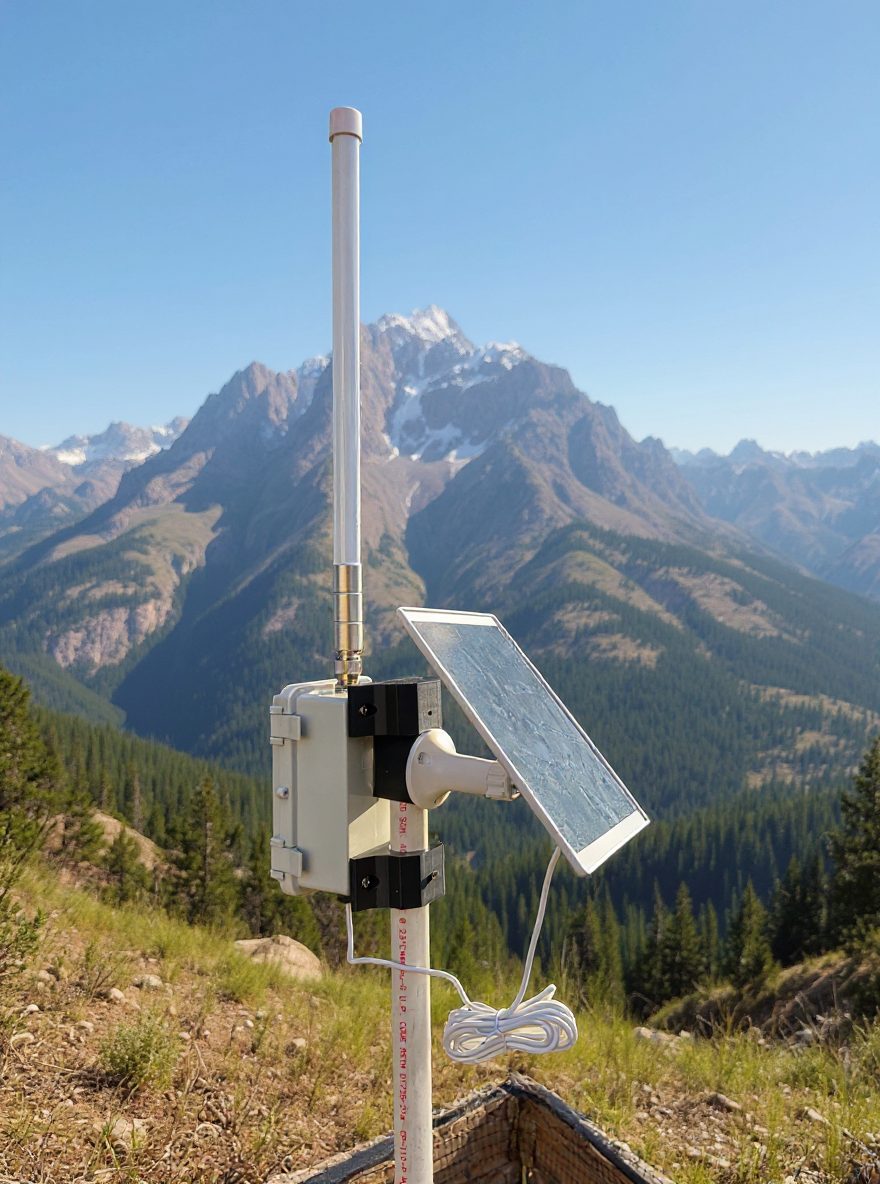
- Solar fixes the recharge problem. A small panel can top up a companion or keep a repeater running for a long stretch, as long as the panel and battery stay healthy. In winter, days are shorter, so size the panel for December, not July. Our solar mesh node build and Texas-proofing guide cover heat, humidity and lightning.
- 18650 vs LiFePO4. 18650 cells are cheap, dense and widely available. LiFePO4 cells tolerate more charge cycles and are generally considered safer. Most lithium cells shouldn't be charged below 0 °C (32 °F), so check the datasheet, since Texas ice storms exist. Our DIY solar repeater guide walks through an 18650 build. The RAK19003 used in our DIY solar build has no battery temperature cutoff, so that protection has to come from the charger or BMS, not the board.
- Keep a spare charged. Top up stored lithium nodes every month or two so they're ready when you need them.
- Generators: use them outdoors, at least 20 feet from windows, doors and attached garages, per Ready.gov. Carbon monoxide kills people in long outages.
Building a neighborhood plan
A mesh is only as useful as the people on it. A simple neighborhood plan beats fancy gear.
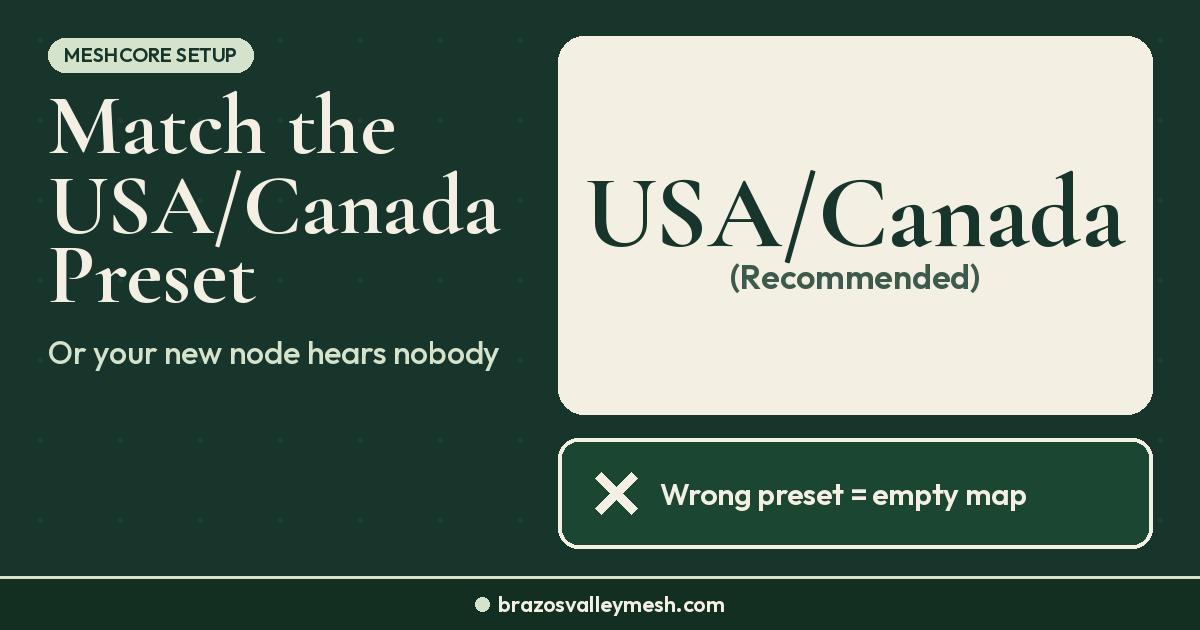
- Pick the radios. Start with two or three MeshCore companions on your street, all set to the USA/Canada (Recommended) preset. One alone feels broken, so get at least two.
- Name roles. One person checks the mesh at set times. Another keeps the paper contact and medical-needs list. A third owns the repeater or the high spot.
- Set check-in windows. For example, the top of each hour for ten minutes, then radios off to save battery. Write it down.
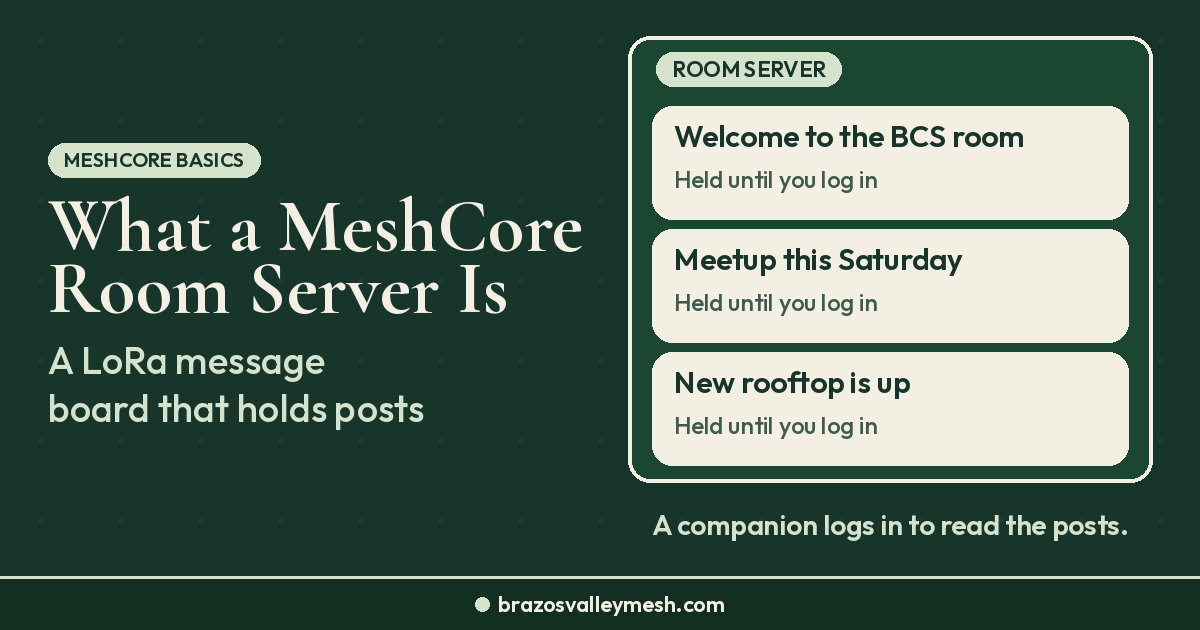
- Share a private channel. Keep neighborhood chatter on a private channel so it doesn't clog the public one. A MeshCore room server can hold messages for people who check in only now and then.
- Plan height. One good roof or tall spot helps more than five indoor radios. Our repeater placement guide covers height and line of sight.
- Stock the basics. Governments in the UK, Japan and the U.S. have been asking people to keep at least three days of supplies, and Snopes notes that's long-standing advice, not a sign of an imminent event. Water, food, medications and cash come first.
- Practice on a calm Saturday. Turn off cell and Wi-Fi, keep Bluetooth on for the companion, and message along a real route. When a drill fails, write down why. It's almost always firmware, preset, antenna or height.
What the Bryan–College Station mesh can and can't do
We'd rather undersell this than oversell it.
What it can do:
- Carry short text messages between companions and repeaters that share the same MeshCore settings, with no tower or internet.
- Keep working through a local outage on solar-powered or battery-backed nodes. Our guide to finding MeshCore repeaters near you shows which ones you can actually reach.
- Give neighbors, crews and campus groups a way to check on each other when phones are jammed or down.
What it can't do:
- It isn't a phone replacement. LoRa is slow and low-bandwidth. It's built for short text, not voice calls, photos or video.
- It isn't guaranteed range. We haven't lab-measured a promise. Expect anywhere from a few blocks indoors to several miles line of sight with a good antenna and height, and trees, buildings and low antennas cut that sharply.
- It isn't statewide. A handheld in Bryan won't reach Dallas. Long-distance needs ham HF, satellite messengers or the phone network returning.
- It depends on who's on it. More repeaters and more people mean more paths. Coverage grows as neighbors join. Check the get connected page rather than assuming.
- It won't help if the radios aren't set up. Wrong firmware or preset means an empty map. Flash MeshCore from flasher.meshcore.io in Chrome or Edge, and match the USA/Canada (Recommended) preset.
- It can slow down when busy. A shared radio channel has limited airtime, so keep messages short, especially if many people are on at once.
Our local mesh after cell fails guide goes deeper on the layered kit and drills.
Gear we'd look at first
Keep it simple. A starter kit is two companions, one better antenna, and a solar repeater if your neighborhood has no height.
- A first companion: the Seeed Wio Tracker L1 Pro can be flashed with MeshCore or Meshtastic, your choice. Around Bryan–College Station, we recommend MeshCore, since that's what the local repeaters run. Wio Tracker L1 Pro (Amazon). Our first MeshCore node guide compares it with other options.
- A ready-made solar repeater: the SenseCAP Solar Node P1-Pro comes in MeshCore and Meshtastic versions, your choice. Around Bryan–College Station, we recommend the MeshCore version.
- MeshCore: SenseCAP P1-Pro for MeshCore (Amazon) ($139.99 as of Nov 15, 2026).
- Meshtastic: SenseCAP P1-Pro for Meshtastic (Amazon) ($139.99 as of Nov 15, 2026).
- From us: our Roamer Companion and Solar Repeater Mesh Node come flashed with MeshCore or Meshtastic, your choice. Around Bryan–College Station, we recommend MeshCore. Buying gear anywhere is fine, and buying from the Brazos Valley Mesh shop helps fund more repeaters around the valley.
Prices and stock change, so check the product pages before you buy.
FAQ
How do you communicate in a 90-day grid-down scenario?
Use layers. A LoRa mesh like MeshCore handles local text, GMRS or FRS handles local voice, ham radio (including HF) handles longer distances, and NOAA Weather Radio brings in alerts. Add solar or battery power for each, plus paper contact lists.
Is a 90-day blackout actually coming?
We found no credible source saying so. PolitiFact rated the Nov 17 claim False, and the Pentagon's 90-day figure is a military preparedness target, not a civilian forecast. A 90-day outage is a worst-case planning scenario, not a prediction.
Was this week's outage a cyberattack?
None of the major outages this week, including the FAA ground stop, Apple and the NSA network issue, has been tied to a cyberattack by the companies or agencies involved. Cyber threats to energy systems are real, but a confirmed cyber-caused U.S. blackout hasn't happened.
Does a MeshCore mesh work when the power is out?
Yes, if the radios have power. Companions run on their own batteries, and solar or battery-backed repeaters keep relaying. A repeater plugged into the wall without a battery goes down with the grid.
Do I need a license for a LoRa mesh?
Not for normal use on the U.S. 915 MHz band with stock MeshCore or Meshtastic settings. GMRS and ham radio do need FCC licenses. See our Meshtastic ham license guide.
Can a mesh replace my phone in a long outage?
No. It carries short texts between nearby radios. Keep your phone, and use the mesh as one layer for local check-ins.
Should I use MeshCore or Meshtastic?
Either works for a personal setup, and our shop nodes come flashed with MeshCore or Meshtastic, your choice. They don't talk to each other, though. Around Bryan–College Station, we recommend MeshCore, because that's what the local repeaters run.